Desensitisation therapy AKA Exposure therapy

@Rachel_Scope and I were talking about using desensitisation therapy AKA exposure therapy to address problems that we have with anxiety. Here's a thread for that, which of course anyone can join.
This therapy can be used to gradually expose us to feelings and thoughts and even physical symptoms, with the goal of decreasing avoidance and decreasing anxiety. This is the relation between anxiety and avoidance, whereby when we feel anxiety we tend to avoid that which causes anxiety, which causes a feedback loop to increase the anxiety...
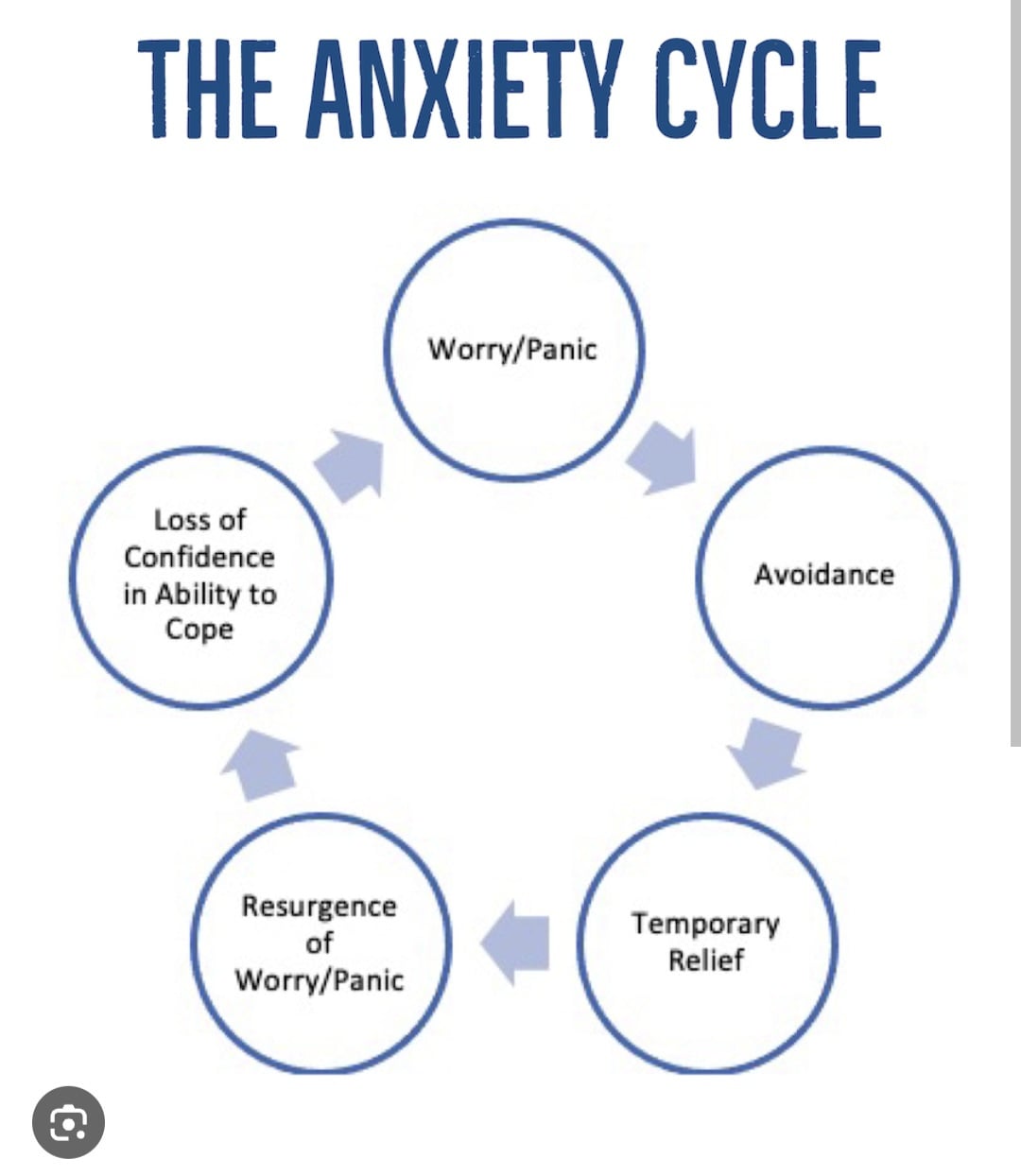
There are four possible approaches I can suggest:
1. Self-directed: Watch this video by "Therapy in a Nutshell" and set up your own program:
2. That video is from day 27 of a 30-video free program by "Therapy in a Nutshell", in this playlist. You can do all videos.
3. You can start with the video in option #1 then do the 30 videos in option #2 as you're working through the program you set up.
4. You can go to the course on the "Therapy in a Nutshell" website and do the 30 videos with more support, which is €37 for one month, found here:
My choice is #3.
There are lots of other options of how to learn exposure therapy. Maybe you want to suggest another option?
DISCLAIMER: I'm not a therapist, just a user and big fan of this technique.
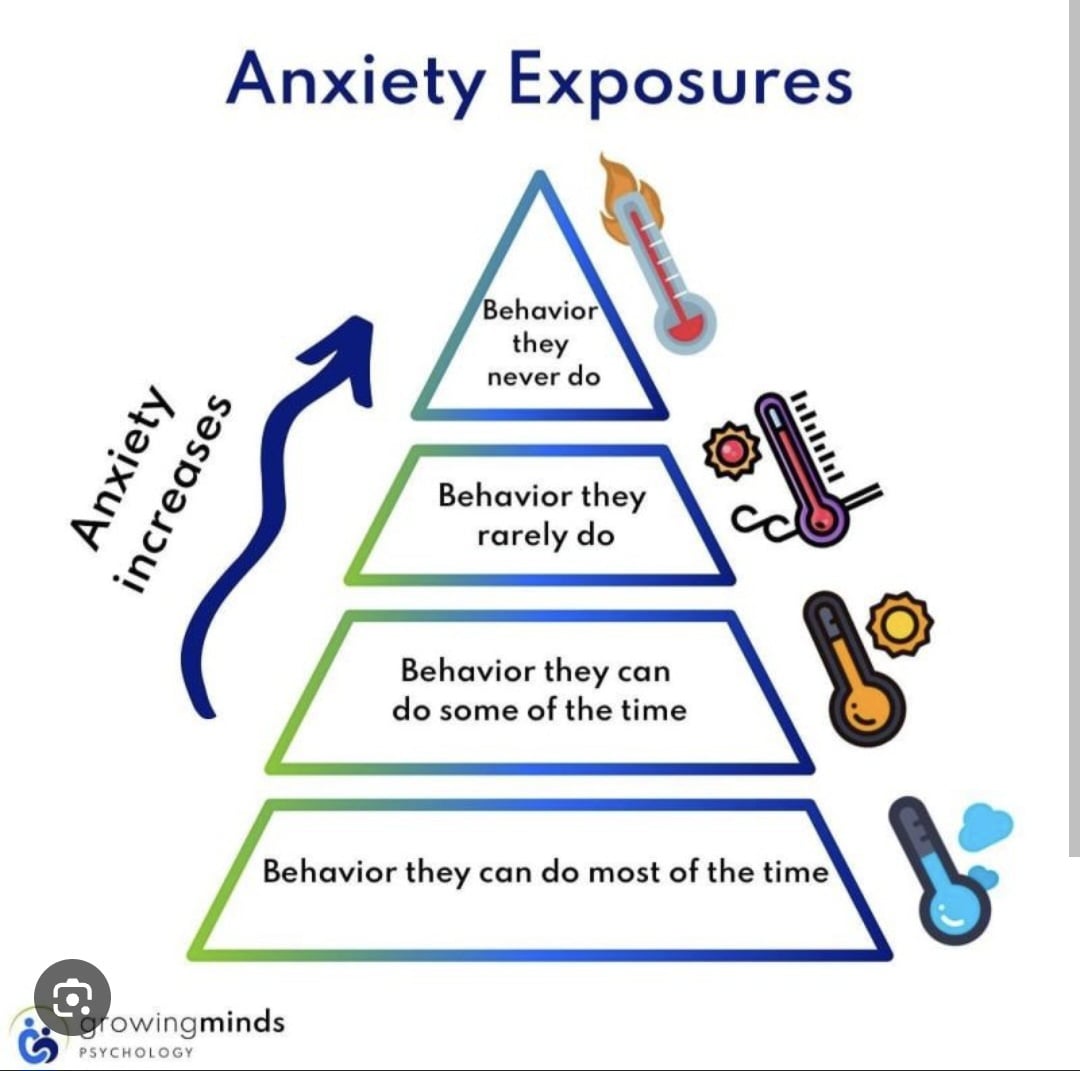
The idea is to create a ladder from easiest to hardest, with the hardest being your ultimate goal and something that you typically cannot do.
Comments
-
Thanks for sharing all these resources @StarryEyed! Rachel will be really pleased to read this thread when she's next in. I'm much better than I used to be, but I definitely still recognise some of that anxiety cycle. Gets me thinking about what I could challenge next!
I love those Therapy in a Nutshell videos, I've seen a few of her other ones. I find the lady who does them really calming and gentle.
0 -
Hi @Rosie_Scope. My pleasure. Hopefully someone will join me. Maybe even you? I learned it about 20 years ago and very quickly learned just to do it in my head, but as I wrote in another thread recently, I'm really, really struggling with my disabilities more and more, so I need more support. I've also seen some of her videos on YouTube. Yes, she is so calming and gentle. I like her very concrete teaching method too and her humour. Here's one of my favourite ones. This is for intrusive thoughts, which is something that gets in my way a lot and is part of the rewiring I need to focus on for my exposure therapy. Maybe you or other members might benefit from this....
1 -
I'll have a think about some things I could challenge @StarryEyed! It's nice to have a spot to share resources and encourage each other too ☺️ I'm sure many will find it useful.
0 -
Okay I've set my ultimate goal:
To be able to take the bus when it is full of people with any of my mobility devices (I have two different walkers, an e-tricycle and an electric scooter).
The next step is to define smaller goals that build towards that goal.
0 -
In the video in option #1, there are six steps to setting up your exposure therapy program. Step one (which was my last post yesterday) is to choose a fear to work on.
Step two is to make a personal goal in your program. My goal is to reduce my anxiety as my anxiety is through the roof about too many things right now - especially (but not limited to) the threat of natural disasters, the global political situation, the global financial situation, and my autonomy decreasing as my health is worsening which makes me increasingly vulnerable. There isn't much I can do about those things, but I'm looking for things I can do something about. I've always had a psychological fear of transportation, but this has become much worse with my physical disability as it's now even more challenging. So my personal goal is to reduce my overall anxiety load and to increase my mobility.
I also watched the Introduction video in the 30-video playlist. She's very clear and focused as to what she will teach us in this course. I like clear and focused - the Holy Grail in anxiety disorders 😊
0 -
I'm so happy to see this @StarryEyed! I haven't had chance to watch the videos yet but I'll try later.
I'll set a goal like you have 😊
Ultimate goal: To go to the supermarket alone and do a full shop.
A smaller goal to start with is to go to the coop over the road and buy a couple of things that we need 😊
I'm sorry you are worried about so many different things. The world can be a scary place so it's important to centre yourself and take time to be mindful. Do you consume a lot of media? I don't watch daytime talk shows or have any social media and I feel much better for it. I keep up to date with a bit of news but try not to dig too deep and get overwhelmed. The media has a lot to answer for with its scaremongering!
1 -
Hi @Rachel_Scope. Great goals! Yay! I'm on step 3 of 6 steps now, which is setting up the hierarchy of desensitisation steps. In case it's not clear, this is the video I'm getting the 6 steps from. (After doing this video, I'll do the 30-video course.)
As for anxiety about world events, it's an appropriate level for what's going on. I'm very clear on knowing that's out of my control. Remember the emergency preparedness program I'm working on? Well that's desensitisation work too, and I've come to a point where I need a more structured approach to facing my anxiety with that too. So this anxiety course will hopefully help that too.
0 -
Yes I do remember your emergency preparedness program! How is it going?
I love structure so this sounds great.
0 -
The emergency preparedness is going really well, and I've finished phase 2 of 6.
Re the hierarchy, I decided not to do one for now. I'm just doing one step at a time. Instead I'm focused on practicing on how to move my mobility devices at home and close to home, which is something I've never done. It's incredible how uncomfortable I am with them. I've also got them in plain view now in the apartment (rather than in the storage room), so that I can get comfortable with them. I'm also imagining taking the bus with each of them, and figuring out the problems I have specific to each device - and there are lots! I had no idea how difficult taking the bus is.
0 -
That's a great idea to get more comfortable with your mobility devices. Was there a particular reason that you kept them hidden away? I hope that once you get comfortable with them and figure out how to overcome the problems you'll feel more confident about taking the bus 😊
I managed to go to the little coop over the road yesterday after a week of avoiding it 😊
0 -
You went to the coop already??? But you just set the goal. Wow!! Good for you. You Go Girlfriend!!!
Yes, I had them stored to keep the place tidy looking. They're not very decorative. 😁
0 -
Only to the little one. I haven't been anywhere near a big shop yet! It really shouldn't be difficult to go to the little coop as it is literally across the road, and I know the staff and the layout. But we know how brains can be! 😅
Ah I see. Could you maybe use your artistic skills to make them more decorative? I remember a young girl who ended up needing a walker and her mum decorated it with ribbons and beads!
0 -
@Rachel_Scope What I mean is it was just on Sep 29 that you set your small goal to go to the coop. 👍🏼 So are you going to increase your time there until you're comfortable? How was it?
The mobility devices will stay undecorated as I'll probably only have them out in view for another week.
0 -
Oh maybe I'm being a bit harsh on myself then? As you say I only set the goal recently and I did it! It was fine because I only went in for one thing and I was distracted about something else so I didn't get chance to really feel too anxious about it. Yeah I think I'll try and go more often or spend longer there. I thought about challenging myself to pick up an item on every aisle to look at 😊
Fair enough. You'll need space for your Halloween party!
0 -
That's what Emma McAdam teaches in the anxiety course - to start with a very short exposure. So you did great. Yay!
To practice, I'm going to set up a mock bus in my living room today. 😁
0 -
I absolutely adore that idea! It sounds like a great way to practise using your mobility devices and seeing what issues might occur. Are the buses there accessible?
0 -
Thanks for your shared enthusiasm about the living room bus. 😁
There is limited accessibility here.
My biggest challenge is that I've lived my whole life dissociated from my body. The past 3-1/2 years since my feet gave out on me, I've worked very hard to learn to connect to my body. I can do it at home now. But when I walk out my door, I still automatically disconnect. Having to move a mobility device forces me to pay some attention to my body, but I'm still not connecting properly. And whenever I'm up against a challenge that is overwhelming and/or anxiety provoking, the dissociation worsens and I have a panic attack, which causes everything inside and around me to fall apart. My greatest challenge has always been transportation in cabs and buses, less so metro and even less so trains. Being trapped because my feet don't work is also a trauma trigger. So there are a lot of challenges to overcome.
To begin with, my goal is to learn how to move my body on the bus first at home, where I can now connect. If I can accomplish that, then hopefully the skills I learn at home will transfer outside of the home in all situations, including taking transportation.
0 -
In addressing anxiety, the most important step for me is to figure out if my anxiety is appropriate. Sometimes I'm anxious for good reason and sometimes it's not fitting. After much thought, I've come to the conclusion that my fears with taking the bus are valid fears because the bus is unsafe for the following reasons:
- The bus driver will not wait for me to get settled, so I have to try to get to a seat on a moving bus while simultaneously having to find a place for my mobility device. This is so clearly very dangerous. I have called the bus company in the past and they said the driver does not have to wait because they have to keep a schedule.
- When I go with my walker, people often refuse to give me a seat saying that I already have a seat with my walker. They refuse to see that a walker cannot be used as a seat on a moving bus. Also there are very few disability seats, so they're often not available. So I'm left standing, trying to manage my body as well as my mobility device, which is very dangerous.
- There is an area where you can put mobility devices, but it is too small for my scooter to fit, so I have to be partially in the aisle. Also, there is no way to secure my scooter because of the design of my scooter (hard to explain but there's no way to anchor it). Also the brakes on my scooter don't work on the bus (as they're not meant for a bus), so it slides across the bus when turning corners or the bus brakes are hit hard. So the scooter is at risk of hurting someone else and the scooter brakes will be destroyed.
- For my e-bike, I cannot figure a way to secure it in the mobility device zone because the seatbelt there typically doesn't work or is nonexistent and I can't find anything of my own to secure it. Plus I cannot stand there to monitor my bike because I would have to stand, and my feet cannot handle the strong forces of the bus movements - my feet don't work, which is why I need mobilty devices.
I have a carbon fibre walker made by byAcre that is lightweight and the rear wheels can typically fit under the seat. It is difficult to maneuver on a moving bus and not possible to use standing. But I'm thinking with practice I might be able to get comfortable using it on a bus that has available seats. The problem with this walker is like with all walkers, that I can't go far on my feet, but there are times when it's suitable. So this is the only option I have right now. I'll work on that.
For the other mobility devices, I will set things in motion to solve the problems, starting with making an appointment with my GP to see what she can suggest. Movement is not optional. I do not have to live like a trapped animal. Or at least I can try to get out of my trap. Even the exercise of trying I believe to be healthy - even if in the end there is no solution.
I'll work also now on getting comfortable taking the metro and local trains with my mobility devices.
Taxis are very expensive, but sometimes they're a necessary expense. A couple of weeks ago, for the first time, a cab driver told me he had the right to refuse my e-bike because of the lithium battery, even though it's a disability device. But he decided to take me. So this is another transportation problem that I have to address. I will call the cab company to talk to them about it.
0 -
I think that they are all very valid reasons to feel anxious about taking the bus. You have clearly put thought into the barriers you face. What I love though is your determination to overcome these feelings. Speaking to your GP is a wonderful idea and hopefully they can suggest something for you so you can have more freedom. I'm really keen to hear how your 'home bus' has worked for you.
I hope the taxi driver wasn't rude to you. It seems so unnecessary to mention that. Let us know what the taxi company say.
0 -
Thank you so much for your support and encouragement @Rachel_Scope. Because of this, you're a huge reason I was able to do this. I had to use all my skills to calm down enough to see through the fear, to assess the situation. In the desensitisatio video I'm doing - this one
Emma suggests one of the ways of approaching your hierarchy of fears is to imagine the fearful situation, which is what I've been doing. I've been imagining every step, but I had to calm down first to imagine, to see all the steps clearly.
Realising now the danger I've been in, I'm just so very grateful that I didn't hurt myself or someone else.
I haven't physically set up the bus yet, but imagining it yesterday did a world of good. Because I dissociate from my body, I can tolerate an incredible amount of pain because I just block it out. So moving my body in various new ways with my different mobility devices (each requiring different movements), and moving the devices themselves in different ways all require me to connect to my body to minimise strain. In particular I've learned at home how to move to manage my foot pain, back pain and shoulder pain. So I'm going to start to practice these movements at home. Hopefully I can learn to connect to my body in the various mobility devices.
1


Categories
- All Categories
- 16.4K Start here and say hello!
- 7.8K Coffee lounge
- 123 Games den
- 1.8K People power
- 188 Announcements and information
- 25.9K Talk about life
- 6.2K Everyday life
- 444 Current affairs
- 2.6K Families and carers
- 889 Education and skills
- 2K Work
- 630 Money and bills
- 3.8K Housing and independent living
- 1.2K Transport and travel
- 674 Relationships
- 1.6K Mental health and wellbeing
- 2.6K Talk about your impairment
- 885 Rare, invisible, & undiagnosed conditions
- 949 Neurological impairments and pain
- 2.3K Cerebral Palsy Network
- 1.3K Autism and neurodiversity
- 41.8K Talk about your benefits
- 6.2K Employment & Support Allowance (ESA)
- 20.6K PIP, DLA, ADP & AA
- 9.5K Universal Credit (UC)
- 5.4K Benefits and income