New accessible flat still presents challenges for wheelchair user

Article written by Emma Purcell in Crip Life
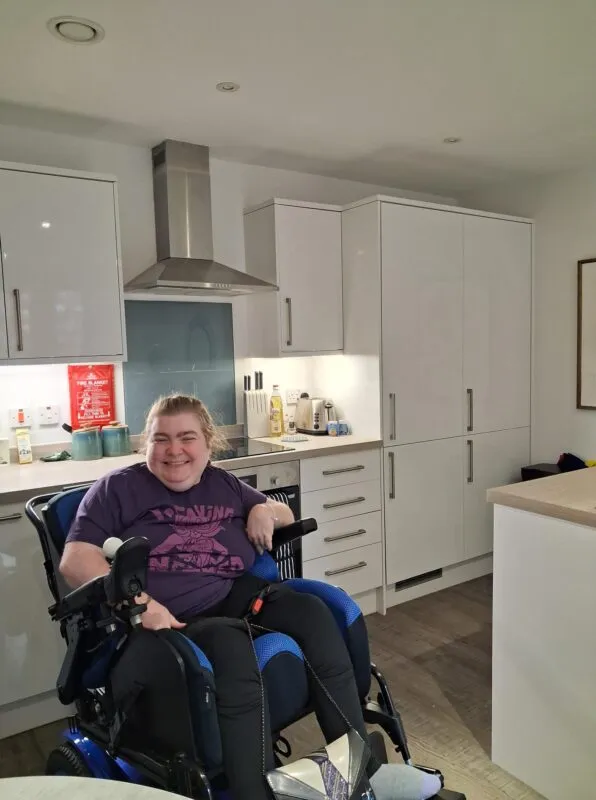
Sophie moved into the new alternative flat temporarily starting on 22nd May 2026, but an immediate permanent relocation isn’t possible at this time as Sophie now has the additional challenge of needing to restart recruitment for two new PAs. Therefore, she will continue to live in her family home in Birmingham until her care support is in place, and then she can return to Southampton full-time.
However, Sophie is still going down to the flat for prolonged periods and stays, as she still has a life down there and doesn’t want to sacrifice that for anything.
She said: “It is great to live in Southampton again. It really is home for me now. Very excited to be back and have elements of my independence back. The ability to take a breath. Can’t describe the feeling of being back, really. ”
Regarding how Sophie feels about this new alternative flat, she said: “In comparison to the other flat, it is more modern and tech-outfitted, but it’s a lot smaller and I, for one, am struggling with the size. It’s more challenging to manoeuvre around, and there are times I have struggled with turning circles. With the space and layout of the bedroom, I struggle to use it as a break-out space and use the living room, which is fine, but it’s not my own space.”
She continued: “The bathroom’s orientation is challenging. It’s wider rather than longer, and as a result my wheelchair cannot get in properly, as well as myself and another person. It takes a lot of in and out, angling ourselves to try and fit. It’s okay, but it’s challenging. The bath is also difficult but doable. It’s nice to have a bath again.”
Sophie also shared how she loves being able to get on the level patio and being outside, which has been good in this hot weather, and it’s much easier to be on the ground floor (especially when the lifts break down all the time).
Sophie also appreciates the communal spaces as part of the complex, such as the communal lounge and kitchen area. There is also a gym and garden area.
Sophie added: “It also has a good public feel, especially the activities available to sign up for and be a part of.”
At present, residents of Admirals Quay have recently been told that they can start moving back in August 2028, which is another two years. But something tells Sophie that “this is just words”.
Reflecting on her journey, Sophie concluded: “Don’t get me wrong, I am so glad we have a new alternative accommodation that has been leased to me for two years, and happy we keep fighting as it got us what we were entitled to. But I am tired of fighting. The lease is for two years, but I am very sceptical about the time it’s going to take to rebuild our flat.
“As of July 2026, it was 12 months since we were evicted, and 13 months since it all started. The whole journey has taken its toll on my health and confidence. I’ve had a regular changeover in personal assistants due to significantly changing locations and having to change my life around, living in a different location even if it’s my family home, getting used to different routines as I try to adapt, and now I need to do it again. Society says it’s improving, but if that’s the case, why do those with disabilities who have to deal with excruciating pain on an hourly basis and who knows what else have to fight so hard for what a non-disabled person is entitled to without question?”
A property may be described as accessible, but that does not necessarily mean it works for the person living in it. From bathroom layouts and turning spaces to hoists, care provision and communal facilities, seemingly small details can have a significant impact on independence.
Have you ever been offered accommodation described as accessible that did not meet your actual needs? Share your experiences in the comments box, on social media or contact us to share your personal story.
Categories
- All Categories
- 16.4K Start here and say hello!
- 7.8K Coffee lounge
- 123 Games den
- 1.8K People power
- 190 Announcements and information
- 25.9K Talk about life
- 6.2K Everyday life
- 445 Current affairs
- 2.6K Families and carers
- 890 Education and skills
- 2K Work
- 630 Money and bills
- 3.8K Housing and independent living
- 1.2K Transport and travel
- 676 Relationships
- 1.6K Mental health and wellbeing
- 2.6K Talk about your impairment
- 885 Rare, invisible, & undiagnosed conditions
- 950 Neurological impairments and pain
- 2.3K Cerebral Palsy Network
- 1.3K Autism and neurodiversity
- 41.8K Talk about your benefits
- 6.2K Employment & Support Allowance (ESA)
- 20.6K PIP, DLA, ADP & AA
- 9.5K Universal Credit (UC)
- 5.4K Benefits and income