Asexuality and Autism

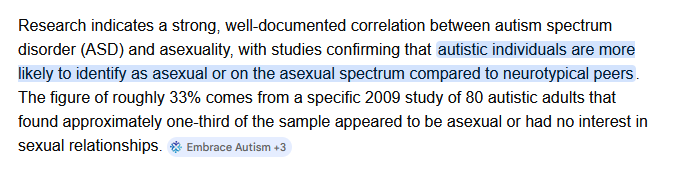
Apprently 33% of people with Autism have some form Asexuality compared to the 1% of the general public.
Is there any other people who have Autism and classify Asexual?
I've always been so conflicted with my sexuality over the decades, I've never felt attraction to others however I can get attracted to a person based on their personality and gender doesn't matter. However I've never ever been able to perform in the bedroom, I really really hate to be touched and everytime I have been forced into a situation I have always freaked out and backed out. So I'm still a virgin at 35 and have no desire to change that. It was only around 5 years ago I realised I was Asexual.
I don't know if my asexuality comes as part of my autism or the fact I had bad experiences growing up when I was young (SA) or both.
Does anyone else appear on the asexuality spectrum?
Comments
-
This is something I find very interesting.
I don't classify myself as anything yet. I still don't really know even after so many years on this planet. (Unless I'm just in denial?) When it comes to filling in forms I still put 'prefer not to answer'.
I've never had any desire for a physical relationship with anyone. But I also hate being touched in any way at all. And am incredibly sensitive to being touched anywhere by anything. When I was younger I was constantly being told that things 'didn't hurt' or 'can't be that bad'. After a while I thought people were just lying to me to make their own lives/jobs easier in the short term. But it's only in the last 5 years or so I've realised they may actually be experiencing the same things in a very different way than I do. And if that is the case then it means there can't be any 'help' with my conditions, as other people would never be able to understand them from my perspective.
In addition to that, I find bodies (mine, other humans, even animals) to be 'repulsive' for want of a better word! It's the physical feelings of bodily processes that I find intolerable, and obviously there is never any escape from them. I am also incredibly physically empathetic and often feel any sort of pain or discomfort that I see or hear in others, in my own body at the same time. So have to try and block that as much as I can, which can make me seem harsh and insensitive, when the reality is the complete opposite.
This has had a huge impact on my life because family members and health professionals were always pushing their agenda about finding me a conventional partner, instead of trying to help with the actual health conditions of finding basic daily life intolerable. I understand their lives are all about finding partners and being with people for as many years as they can, but that was never the direction mine would take.
I can see when a person looks attractive compared to 'average' people, so thought that would rule me out of the asexual label, but as you say it's a spectrum, perhaps not. I haven't been diagnosed with Autism as I can't access the assessment now, but am almost certain that I'm on the Autistic spectrum based on the over-sensitivities that I have, the fact that I don't have any desire for the 'standard' life path of finding a partner and having kids, and the fact that I get constantly misunderstood in real life, as if I'm speaking a different language.
1 -
So many things you have said align with myself, especially the over-sensitive/sensory stuff and being misunderstood all the time. In the past I tried to have relationships as my family kept suggesting I find someone as they see it as the "norm" thing to do, so I used to push myself to find someone. Although I had no real physical attration to another person I did find that I have attration to another persons personality but as soon as they tried to get intimate with me I would freak out as I am overly sensitive and hate being touched. It was only a few years ago I came across the term Asexual.
1 -
When i was younger it was always the person i was attracted too i have to admit was a total nightmare being in relationships as i do not like touch either and im highly intuned to people and foumd it impossible to control my feelings so i drank alot to try to be what society expects looking back was so so hard and made me hate myself even more was a really really bad time thinking about it i think its amazing you have insight and are hapoy in your own company because trying to conform causes great mental anxiety accepting what you can and cant tolerate is freeing i spent 40 years trying it nearly kill me i spend all my time on my own and im at peace woth that occasionally i spend time with people on my terms are i umderstand i am drained by certain people and i can only mask for so long who says we should be in relationships married its good you understand yourself at a young age cuts out all the white noise
1 -
I get easily drained too and can only mask for so long nowadays, I'm also not conforming anymore and stressing myself out on what society or family wants me to do. Instead I'm doing what feels right for me and doesn't cause stress, stress is a big big factor when it comes to my Crohns disease flaring or my Schizophrenia getting worst so have to be careful. Its not helpful being autistic where everything stresses you out.
I'm sorry you had such a hard time, luckily things in terms of what society expects has changed more in the coming years. People generally don't rush into marriages anymore or want to even get married. I'm just happy having a few friends in my life, those are the only relationships I need and they are all on the spectrum so know me more than me sometimes.
2 -
Hello @rubin16, I've not been able to find that statistic confirmed anywhere but research does support that there is a higher prevalence of asexuality among autistic or neurodivergent adults compare to the general population. Have you ever spoken to anyone or had support with your bad experiences?
@OverlyAnxious, have you ever looked into Sensory Processing Disorder? People can feel or experience pain and physical senstations differently to other people. Someone I know well has SDP and has described similar things to what you've said with touch, when brushed up against lightly or certain materials create pain signals for them, whereas a time they had a serious injury they barely felt it. There are ways to manage sensory processing differences although these are often targetted at children, but being aware someone processes sensory input differently can help with understanding.
I've always found the links between interoception and autism interesting too. I only found out recently that it's possible to experience interoceptive hypersensitivity (i.e being too aware of body signals and feelings).
3 -
I don't believe that statistic for a minute! I'm no biologist but I say autism would have died out long ago if it were true.
33% of asexual respondents were autistic sounds more likely to me..
4 -
[Removed by moderator]
here is the study: The 33% is taken from a study done in 2009.
 1
1 -
For those who know nothing about it -
The asexual spectrum
The asexual—or ace—community includes a spectrum of identities, including:
- Asexual: Someone who experiences no sexual attraction to others
- Gray-asexual/graysexual: Someone who experiences sexual attraction rarely or only under specific circumstances
- Demisexual: Someone who experiences sexual attraction only after forming an emotional bond
There is a lot more variance and nuance in the ace spectrum, however. Besides the three better-known categories defined above, the following are also part of the ace spectrum:[22]
- Abrosexual/ace flux: Someone whose experiences of sexual attraction fluctuate; they may go through periods of asexuality and periods of experiencing sexual attraction; and they may go through phases of weak or more intense sexual attraction
- Akoisexual: Someone who experiences sexual attraction to people but has no desire to have those feelings reciprocated; for some, if the attraction is reciprocated, their feelings may fade, and they will no longer be attracted to that person
- Fraysexual: Someone who initially experiences sexual attraction upon meeting someone, but this attraction fades after getting to know them
- Lith(o)sexual: Someone who doesn’t like to receive sexual contact, but who may be happy to give it
- Apothisexual: Someone who is not only asexual, but also sex-repulsed
- Cupiosexual: Someone who desires a sexual relationship, but does not experience sexual attraction
- Quoisexual: Someone who is unsure whether they experience sexual attraction, or is unsure about what sexual attraction is
4 -
A study of 80 people? 80 people isn't conclusive of anything.
2 -
[Removed by moderator]
To answer your final question, thats why I used the term "Apprently" its not set in stone meaning it could be couldn't be and I'm just interested in finding others who are similar.
3 -
Ahem, Scope…
1 -
Research shows that "up to 75% of autistic people aged 20–49 and more than 90% of those over 50 are undiagnosed."This means that millions of [autistic] people around the world might not be receiving the support that they need."1 -
Thanks Adrian. I had heard of SPD but never really looked into it.
My main focus has been more practical, trying to physically reduce or remove some of the external sensory triggers so that I could hopefully cope better with a smaller number of sensory inputs at any one time. Unfortunately that involves moving to a different type of property which doesn't seem to be any closer now than it was 5 years ago. I don't feel like I have the spare capacity to be working on any sort of therapy in my current property, where I constantly feel stretched to the limit now. SDP is certainly something I would look further into if I could get the basic practical needs under control well enough to access and attempt therapy again.
0



Categories
- All Categories
- 15.9K Start here and say hello!
- 7.6K Coffee lounge
- 108 Games den
- 1.8K People power
- 166 Announcements and information
- 25.4K Talk about life
- 6.2K Everyday life
- 509 Current affairs
- 2.5K Families and carers
- 876 Education and skills
- 2K Work
- 589 Money and bills
- 3.7K Housing and independent living
- 1.2K Transport and travel
- 647 Relationships
- 1.6K Mental health and wellbeing
- 2.5K Talk about your impairment
- 882 Rare, invisible, & undiagnosed conditions
- 942 Neurological impairments and pain
- 2.2K Cerebral Palsy Network
- 1.3K Autism and neurodiversity
- 41K Talk about your benefits
- 6.1K Employment & Support Allowance (ESA)
- 20.3K PIP, DLA, ADP & AA
- 9.2K Universal Credit (UC)
- 5.3K Benefits and income