Does anyone else have a Listening Disability?

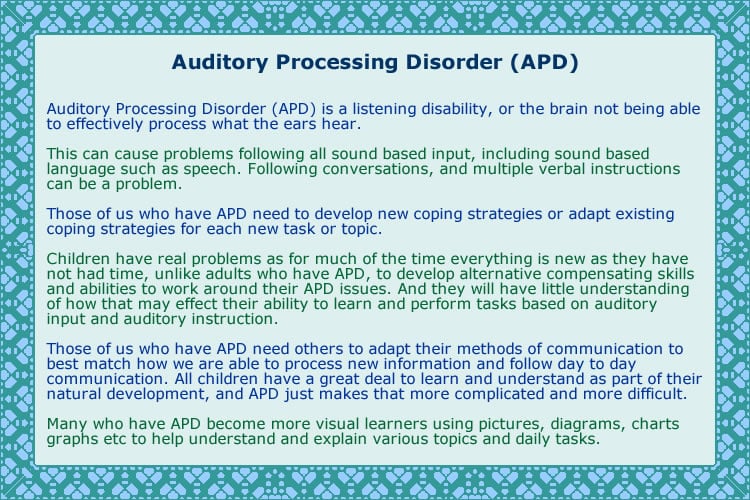
I have a life long Listening Disability, or the brain not being able to effectively process sounds and sound based communication , speech.
The technical term is Auditory Processing Disorder.
I was the first adult in the UK to be clinically diagnosed a having an auditory processing disorder, back in 2003, which was done to help the UK Medical Research Council gain UK government funding for a 5 year Auditory Processing Disorder research program, they needed a national support organisation for those diagnosed as having Auditory processing Disorder. I set up APDUK in 2002/2003 and the Medical Research Council got their government funding in 2004. (research program 2004 -2009 at Nottingham University)
The Medical Research Council recommends that those who have Auditory Processing Disorders (there are 4 types of APD) require life long support from a multi discipline team comprising audiologists, speech and language, and psychologists. Unfortunately so far these professions have almost completely ignored this and other international research regarding Auditory Processing Disorders as they would have to be retrained, and improve the minimum qualification requirements for their respective professions. And their working as part of a team conflicts with their professional egos.
When I have mentioned Auditory Processing Disorder on some Scope threads started by so called medical professionals they have deleted the thread in order to avoid exposing their ignorance and incompetence.
Living with a listening disability is so isolating, and lonely,
In recent years I have become housebound to avoid the disability discrimination and victimisation from others.
Comments
-
Hello @dolfrog. I'm really sorry this post seems to have been missed. I know you're quite frustrated about the lack of awareness of APD. Are there any books you'd recommend about the condition?
I think lots of us can relate to feelings of loneliness and isolation. Do you have much family support?
I hope you're having a good week,
Adrian0 -
Hi @Adrian_Scope
I have a web page that lists some of the books from both researchers, and those who live with Auditory Processing Disorders,
at Evernote "Some WorldCat Auditory Processing Disorders Books"
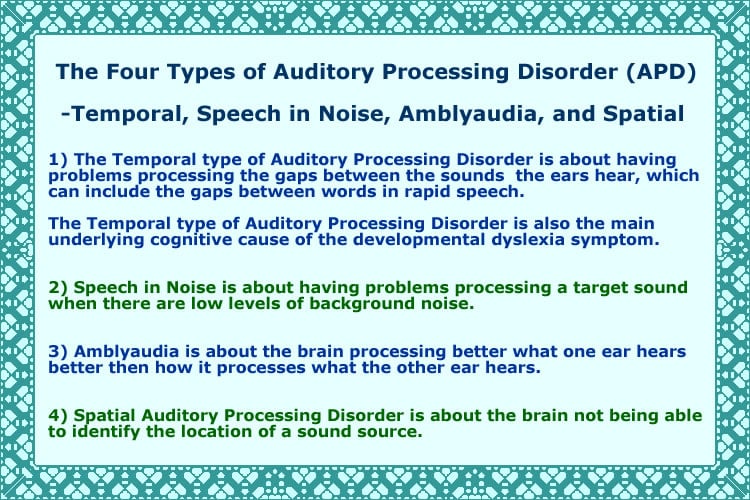
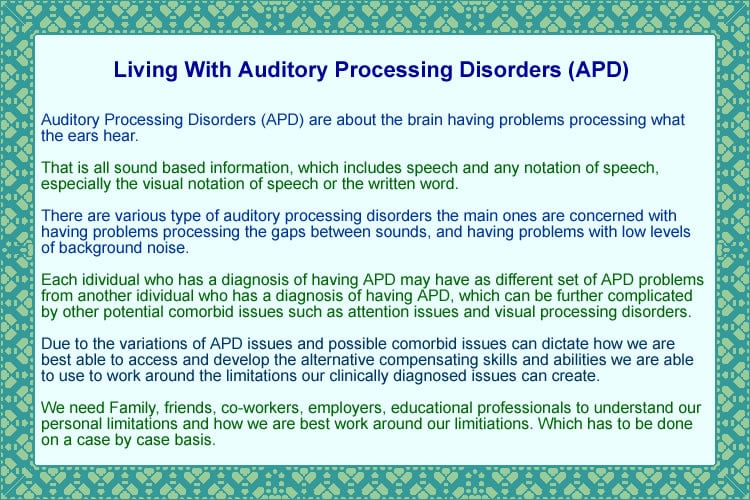
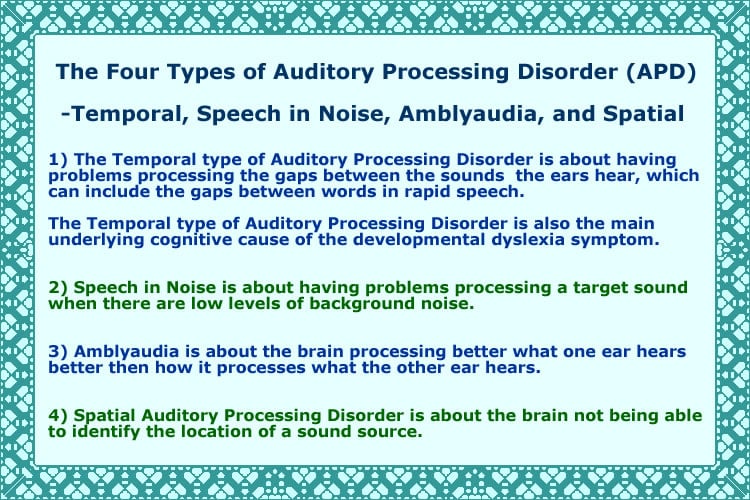
There are 4 types of Auditory Processing Disorders
Speech in Noise - having problems processing a target sound when there are low levels of background noise, some who have these issues have gained some benefit from using FM systems. Especially in classrooms and during lectures and presentations
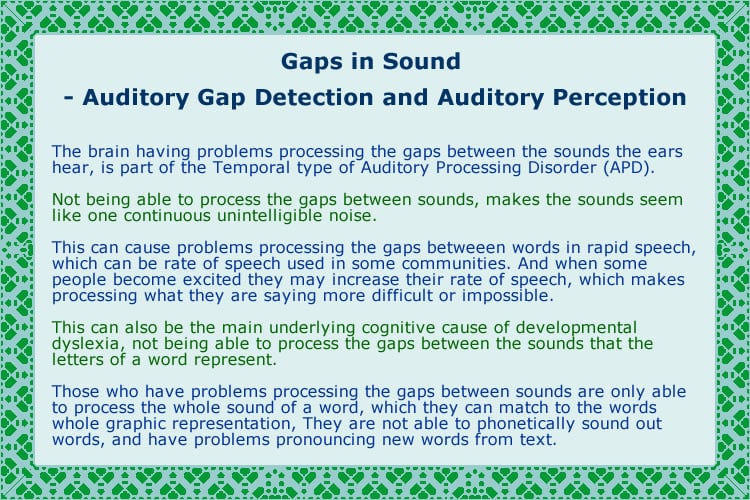
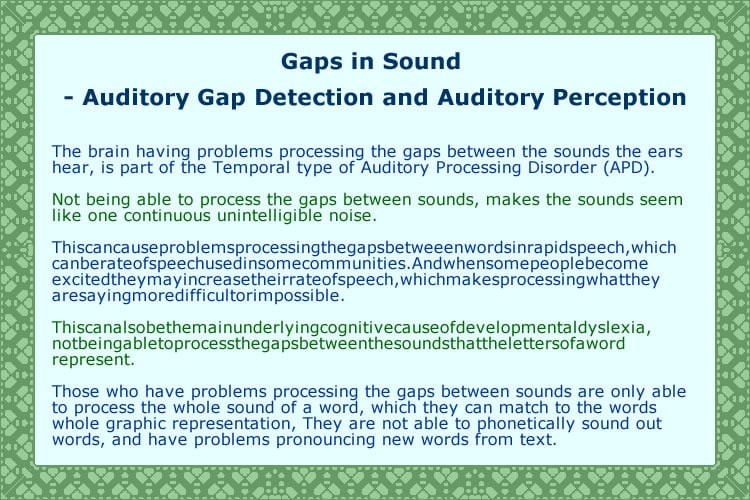
Temporal form of Auditory Processing Disorder - problems processing the gaps between sounds, which can include the gap between words in rapid speech. This is the main underlying cognitive cause of Developmental Dyslexia, not being able to process the gaps between the sounds that the letters in a word represent (not being cognitively able to use phonics), and problems with sound based communication acquisition causing receptive and expressing speech issues.
Amblyaudia - is about the brain processing what one ear hears better then what the other ear hears, dischotic listening issues.
Spatial Processing - problems are about not being able to identify the location of a sound source. identifying where a sound is coming from.
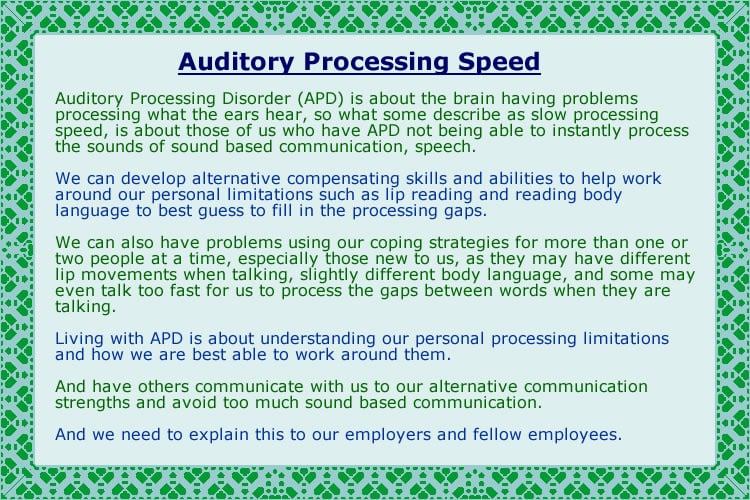
There are also problems of poor auditory memory which can cause word recall problems, poor sequencing skill, and having to run various coping strategies to work around our communication limitations can cause working memory issues. And the stresses and anxiety of living with Auditory Processing Disorders can also be detrimental to our working memories.
2 -
Hi @Adrian_Scope
You asked "Do you have much family support?"
All of my family, 3 sons, my wife and me; have a clinical diagnosis of having some degree of Auditory Processing Disorders
My wife and I were married for over 20 years before we found out about APD, one of the main reasons we understand each other so well. My wife is my carer, I am supposed to be a worst case scenario, and have poor self organisation skills and abilities.
The real cause of my frustration is the lack of awareness of APD and the failure of UK so called support professionals (Audiologists, Speech and Language, Psychologists) to even discuss APD which has a detrimental effect on our sons and my wife. I feel i have failed them when i was running a support organisation to help the UK Medical Research Council fund a 5 year APD research program. The main problem is that these so called professionals do not want to be retrained and use the same terminology to describe the exact same issues. Some so called leading academics are in denial ( I could name them lol).
I can also see that previous generations of my family who were undiagnosed as having APD, due to APD only being recognised in the last 30 to 40 years. Those worst affected are in the native populations in the Pacific regions of Austal-Asia.1 -
Hi @Adrian_Scope
I have recently developed a web page Regarding the Four Types of Auditory Processing Disorder which includes some links to my online Zotero based research paper compilation.
I had to create this compilation since March this year when the UK based CiteULike web site was closed down. I had to download the various research paper collection I had contributed to over the last decade or so, before the CiteULike web site closed down.
I found the Zotero web site a few weeks after they announced he imminent closure of the CiteULike site and i had to work out how best to use their web site is set up.which is very different to the old CiteULike set up.
My Evernote web page "The Four Types of Auditory Processing Disorder" is at
https://www.evernote.com/shard/s329/sh/35c143f8-30d8-4b16-81d9-bb9bbd34449f/23638e20a161955c968bedd5bf0e59c9
1 -
Hi @Adrian_Scope
Last year I was asked by the local Hertfordshire Mind group to provide a presentation regarding Auditory Processing Disorder.
Initially they wanted me to do the presentation in June last year, but I was having to cope with what was later diagnosed as Lymphoedema in my feet and legs, so the presentation was delayed until September.
Another more recent issue is that Evernote has been sold and the new owners want remove the Free service and charge what i consider a large yearly fee. Fortunately my son paid for one more year at Evernote, but I am not having to transfer my all of my note especially my public notes mentioned above, over to Google Notes.
Which is why I have had to renew my Mind Presentation notes over to Google Notes. I also have a pdf version which I have added below.
Once I have finished the conversion of all my old Evernote public APD related pages I will add them to this thread probably in a few weeks time.
0 -
Sorry to read you suffered from lymphoedema.
Thank you, but you have already shared much info on Scope, including this presentation to your local Mind group recently.
On p2 of this pdf I have noted that you mention Prof. Doris-Eva Baminou as the leading UK APD researcher, so you may be interested to read her 'Auditory Processing Disorder - A Professional View' here, if you haven't already seen it (please scroll down to pps 20-21):
APD has been recently discussed here too, with links kindly provided by the Scope team:
Adrian asked back in 2019 if there were any books about APD - there's this one now which was published in 2021: https://www.amazon.co.uk/Auditory-Processing-Disorder-Identification-Professionals/dp/1787752828?keywords=Auditory+Processing+Disorder&s=books&sr=1-1
0 -
You learn something new everyday I don't have a listening disability. Never knew you could have one. You learn something new every day
0 -
Hi chiarieds
I first met Doris-Eva Bamiou in the early 2000s and she clinically diagnosed my wife and one of our adult sons as having APD.
Our eldest son was identified as possibly having APD in 1998 by a support worker at his primary school. And to find out what APD was I scrolled around the internet and found a USA support group which I joined. After 6 months in the group i realised that I had been living with APD all of my life, and a few years later I realised that previous generations of my family had undiagnosed APD and had been hiding their lifelong limitation.
In 2002 My son and I had a meeting with Prof. David Moore in our local disability support centre, where he asked me to set up a support organisation so that he and the Medical Research Council could get government funding for a 5 year APD research program 2004-2009 run at Nottingham University. I set up and helped run APDUK. the lady who now runs APD Support UK was one of the members of the team that joined to help run APDUK.
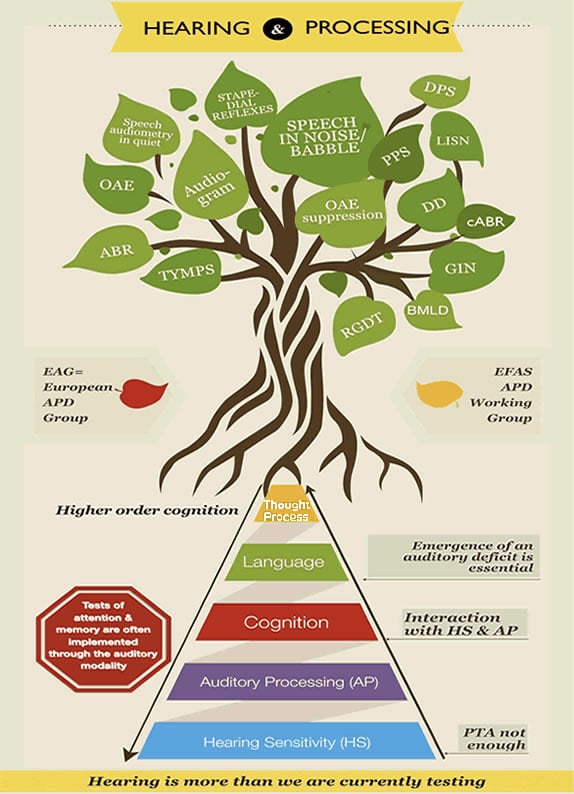
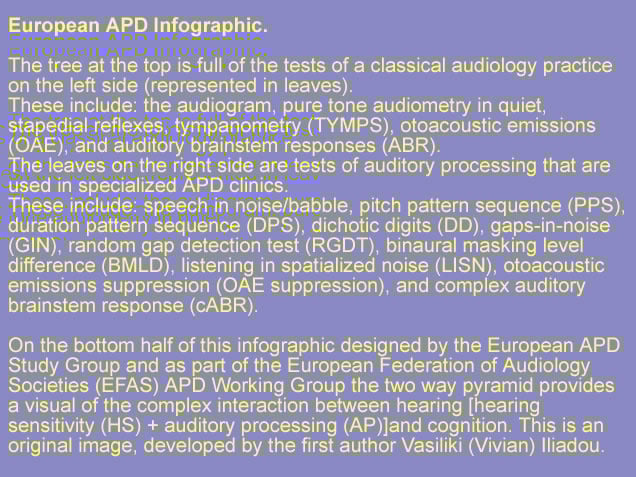
Doris-Eva Bamiou is now part of the European APD research team and the article you mentioned is a follow up to 2019 research paper that the team combined with other international researchers to write, and I included a graphic in my Presentation.
I also have a PubMed collection of some of Doris' research papers
and the lady whose research helps to explain my lifelong issues Nina Kraus
I did reply to Adrian in 2019 regarding books about APD with a link to my web page that lists a some books about APD.
I found out in the 20i0s from a local disability support worker that I should have had a career as an "Indexer" which requires a degree qualification, which being in my 60s was not a real option. Previously I had been told by the manager of the local Jobcentre after I explained my APD issues that I was unemployable and that I should stop getting ESA and move on to DLA.
0 -
 0
0 -
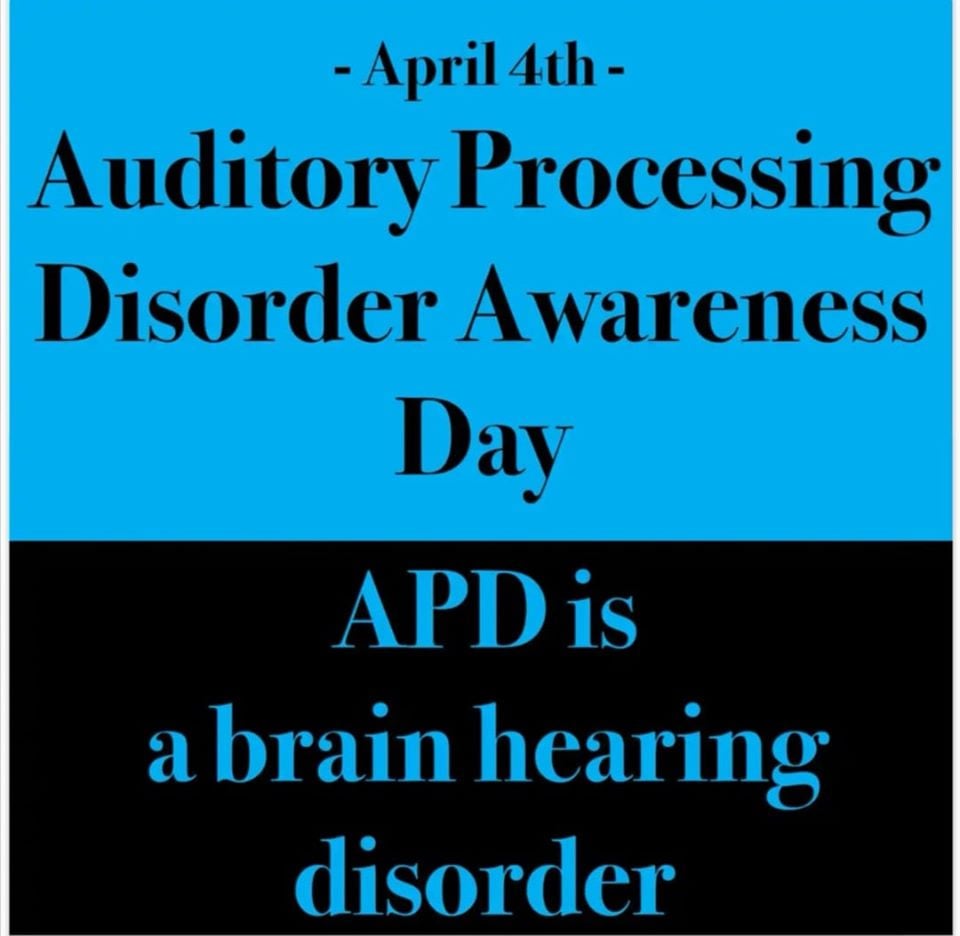
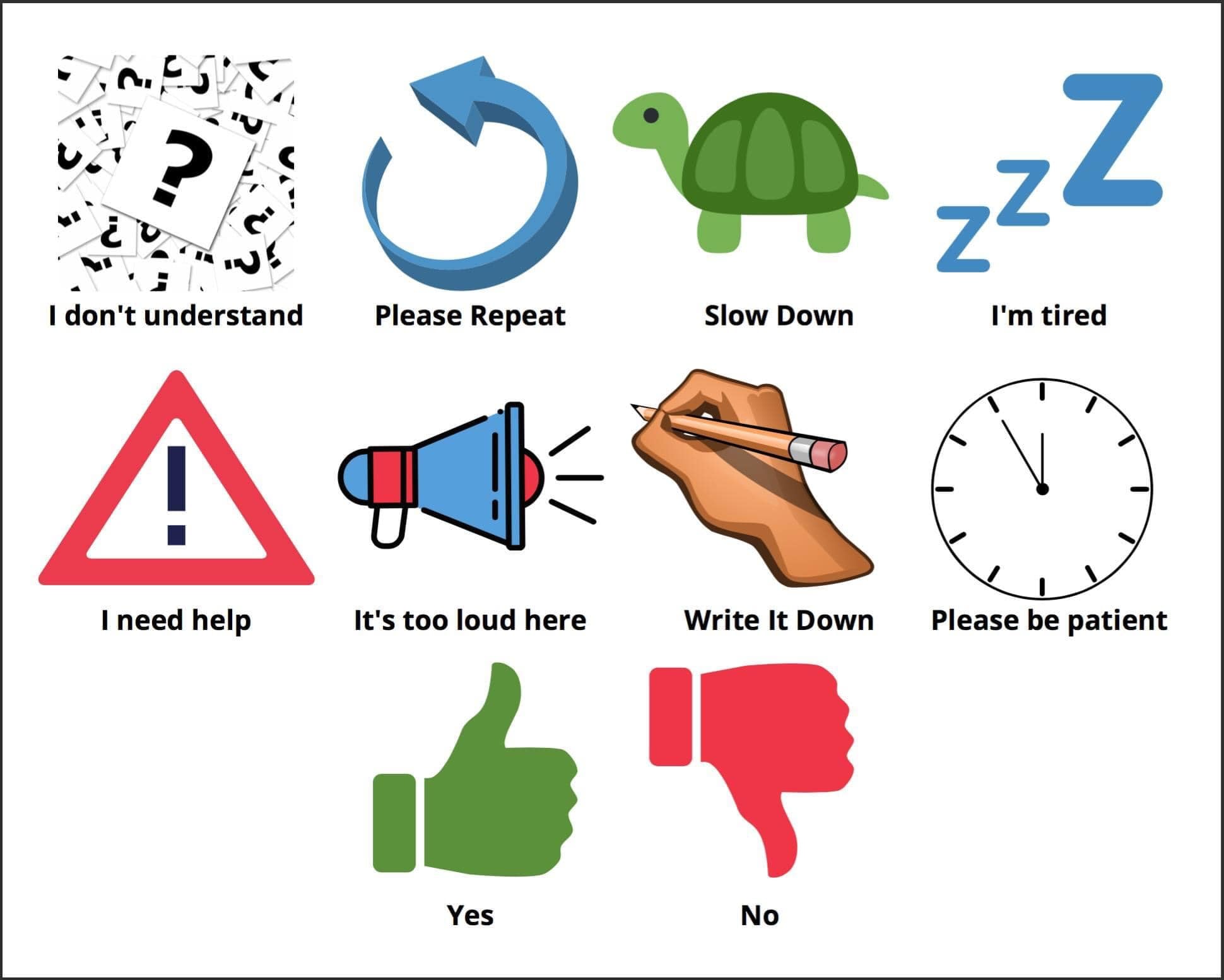 0
0 -
 0
0 -
Didn't know Dyslexia was linked to hearing. I got Dyslexia, Autism. But development tinnitus 8 years ago
0 -
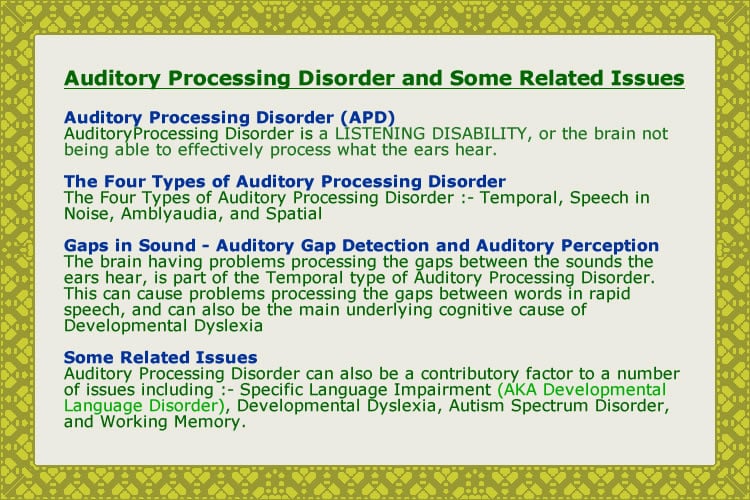
The Temporal type of Auditory Processing Disorder (APD) is the main cause of the dyslexia symptom.
The key assessment test is the Random Gap Detection Test which attempts to measure the size of gap between sounds and individual can process and identify. When I did the test in 2003 it did not include a gap between sounds my ears hear for me to identify. This explained my problems with rapid speech, which to me is one continuous noise, and it explained my dyslexia as I am cognitively not able to use phonics.
And Auditory Processing Disorder (APD) can be one of the multiple issues which combine to be part of an individuals Autism.
I was the first adult in the UK to be clinically diagnosed as having Auditory Processing Disorder (APD) at Sheffield University to help the UK Medical Research Council get government funding for a 5 year Auditory Processing Disorder research program 2004-2009 run at Nottingham University. I set up and helped run APDUK a support organisation to help the Medical Research Council get their funding.
 0
0 -
Unstable Representation of Sound: A Biological Marker of Dyslexia
https://www.jneurosci.org/content/33/8/3500.full
For Reading Development, Auditory Processing Is Fundamental
Auditory Roots of Literacy Skills
0 -
Random Gap Detection Test (RGDT) – Standard
Random Gap Detection Test (RGDT) performance of individuals with central auditory processing disorders from 5 to 25 years of age
https://www.ijporlonline.com/article/S0165-5876(11)00560-X/fulltext
Auditory temporal resolution in adaptive tasks Gap detection investigation
https://www.ncbi.nlm.nih.gov/pmc/articles/PMC6452600/
Biological Markers of Auditory Gap Detection in Young, Middle-Aged, and Older Adults
https://www.ncbi.nlm.nih.gov/pmc/articles/PMC2852420/
Temporal auditory processing: correlation with developmental dyslexia and cortical malformation
0 -
 0
0 -
Hi Catherine
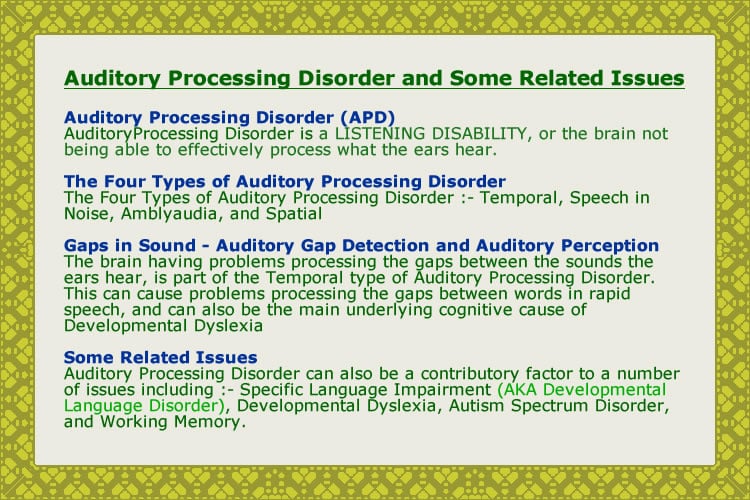
I was identified as being dyslexic in 1996 at the age of 42, and the key test during my 2003 Auditory Processing Disorder clinical assessment was the Random Gap Detection Test, which tries to measure the size of gap between sounds that the ears hear, the brain is able to process and identify.
When I did the test it did not include a gap between sounds large enough for me to identify.
This explained my problems processing rapid speech, which to me is one continuous noise, and it explained my dyslexia as i am cognitively not able to use phonics, identifying the sounds that the letters in a written word represent.
I have to have someone repeatedly say new to me words until I am verbally able to correctly pronounce them
I also discovered that I had become a Visual Spatial Learner from birth to work around my lifelong auditory limitations, and I can visually speed read research papers as i visually recognise new words and terminology, but I am not not able to verbally pronounce the new to me words and terminology.
0 -
Hi Catherine21
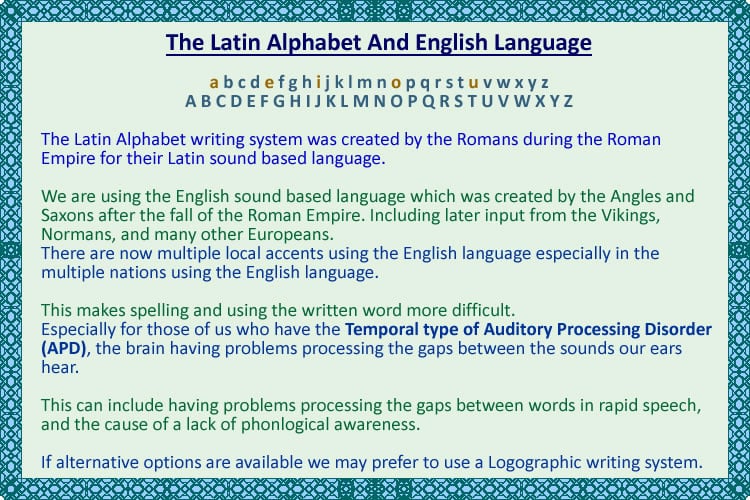
I have a graphic which includes a diagram of the Latin Alphabet which may help.
 0
0 -
Who knew! I miss some words when listening, chatting with people, I also have real problems with speech in noise, just put it down to constant ear infections over 20+ years ago & I put the tinnitus down to them too.
0 -
Constant ear infections can be part of Otitis Media with Effusion
and this can be a cause of one or more of the four types of Auditory Processing Disorder (APD)
Speech in Noise
The Temporal type of APD which can cause problems processing the gaps between the sounds your ears hear, and problems of auditory memory rembering the sounds you hear including speech
and may be Tinnitus as well
I hope this helps explain a few iisues
 1
1




Categories
- All Categories
- 16.4K Start here and say hello!
- 7.7K Coffee lounge
- 120 Games den
- 1.8K People power
- 199 Announcements and information
- 25.8K Talk about life
- 6.2K Everyday life
- 434 Current affairs
- 2.5K Families and carers
- 897 Education and skills
- 2K Work
- 629 Money and bills
- 3.8K Housing and independent living
- 1.2K Transport and travel
- 678 Relationships
- 1.6K Mental health and wellbeing
- 2.6K Talk about your impairment
- 885 Rare, invisible, & undiagnosed conditions
- 947 Neurological impairments and pain
- 2.3K Cerebral Palsy Network
- 1.3K Autism and neurodiversity
- 41.7K Talk about your benefits
- 6.2K Employment & Support Allowance (ESA)
- 20.6K PIP, DLA, ADP & AA
- 9.5K Universal Credit (UC)
- 5.4K Benefits and income