Was "The Great ADHD Myth" Unscientific ?

Comments
-
I have not read the Guardian Article (I don't like signing into things I might not be able to escape from!).
However, I did watch the programme last evening and I agree, this was produced with what appears to be a lot of bias. If memory serves there was no mention of how the child came to be diagnosed in the first instance. What motivated his mother to recognise her child's behaviour was not as she might expect nor how the child's behaviour was very different from his younger sibling or what prompted her to seek a diagnosis in the first instant.
Medications have changed much over the years but I can say that it is not easy to be prescribed medication and the parents have to agree to it. My eldest son was diagnosed with ODD (Oppositional Defiant Disorder) and ADHD at the age of 7years but it took a lot of work to get him there. I noted abnormal behaviours with my son at an early age about 14 months (at this stage mostly oppositional behaviour except I did not know about this condition then, so couldn't have invented it!) It took until he was at Primary School before a problem was identified (despite my constant advising that I felt something was not quite as it should be) School arranged for him to be assessed by Educational Psychologist, who referred him to a Community Consultant Paediatrician, who promptly referred him to the Maudsley Hospital in London. My then husband was against the idea and had been blaming me for being an inadequate parent from the start. However, I had put my husband's objections to the Senior Registrar who spoke to my husband and he agreed for my son to be assessed. Once assessed there was a Case Conference with all the professionals who had assessed my son and the top Consultant at the time during which time we were advised that my son fitted the criterion for both diagnosis. It took another two years (approximately) before his local Consultant would agree to try the medication. Again my husband was against it saying that he did not want our son to become a "Zombie" and be passive because my husband assumed that is what I needed for me to 'cope' with him. My husband was quite shocked to learn that the medication he was given at the time was a stimulant! Completely the opposite to what my husband had expected. Once my son had started the medication my husband told him he could stop taking it if he wanted to. After a couple of days he asked my son "how he felt?" My son's reply shocked my husband as my son told him "Like a thick fog had lifted and he could think more clearly!".
This programme only appeared to have the views of people who showed negativity to the diagnosis as to shift 'blame' on education. Whilst I agree better educational needs are required to integrate children into mainstream schools with adequate support, it is equally unscientific not to have asked the information from those who have studied and identified this condition. I do not believe this programme addressed this fairly.
I was told by the Consultant prescribing for my son that if he did not have this condition the medication would be ineffective. My son and school realised that it helped him to focus whilst at school. I do wonder if children are being labelled without a fully investigated diagnosis and perhaps part of the problem is in the length of time it takes to wait for referrals then wait for the investigations before a decision is made.
My son is now 36, is a singe parent and manages his condition (without medication) with coping strategies.
0 -
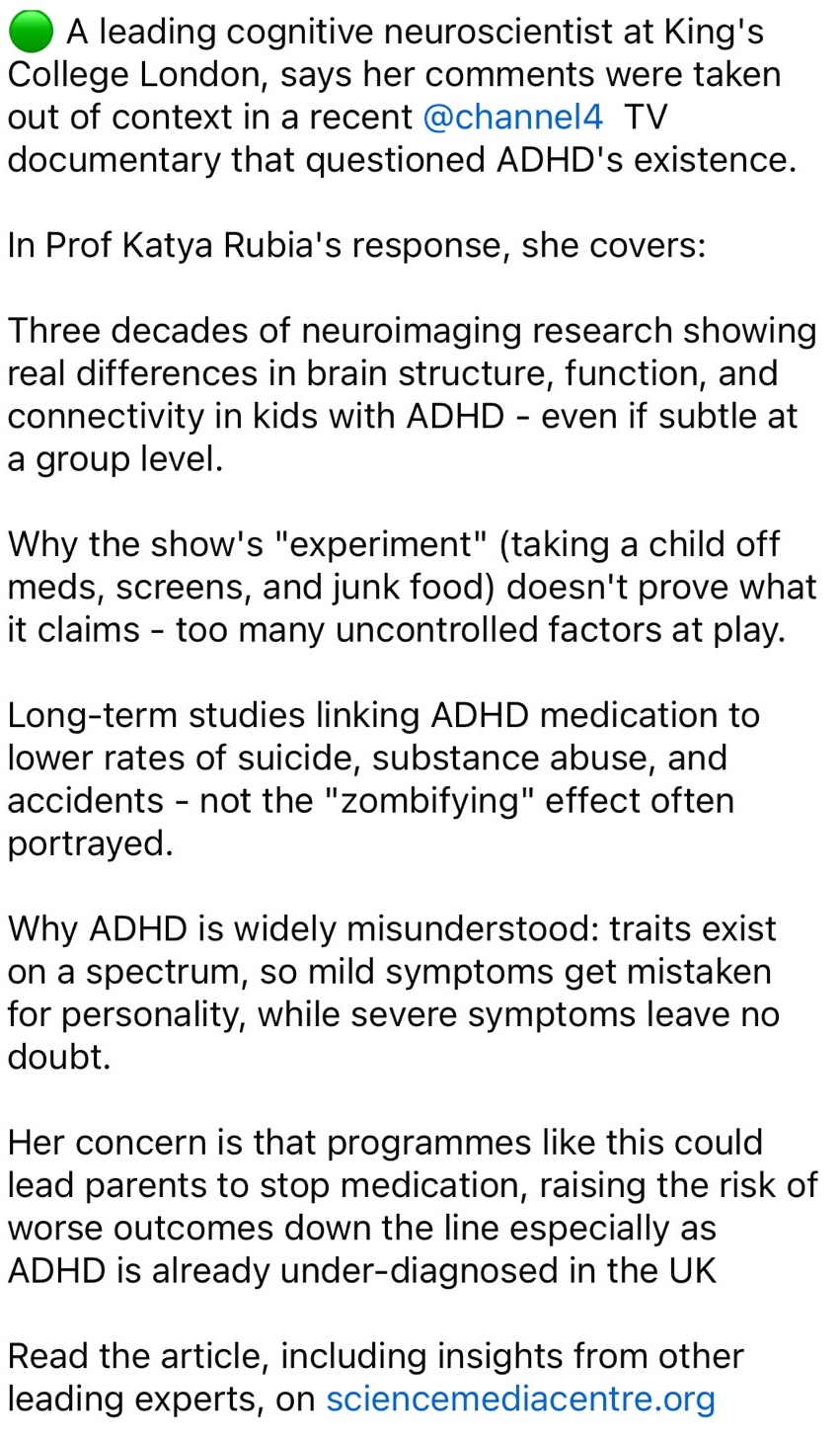
I'm only half way through the show but saw this today:
 1
1 -
No signing in required, just tick on the cross in the corner of the message. The Guardian doesn't have a papaywall either.
0 -
#ChrisR777,
Thank you for the link. I've just read some articles but not sure I managed to read the article in the Guardian.
That said, it was interesting to read that some of the professionals interviewed have said that they feel their interviews were taken out of context!
What was also interesting was the point made by ADHD UK that this condition has been identified since the 1700's! A lot longer than I was aware of, although I read some time ago that this condition (although not labelled as ADHD at the time) goes back to a British physician who recognised these behaviours in boys in particular in 1937. The physician requested funding for research but was refused at the time. It took a physician to read the British physicians notes and was able to get funding in USA to study and publish his findings. It took many years before this condition was recognised as a formal condition and accepted by the WHO and published in the Diagnosing Manual.
I am thankful that my son was able to go through the process by today's waiting times relatively quickly, although it took another two years for him to be medicated that by his own words enabled him to be more focused particularly during school time. It is soul destroying to think that many people are 'struggling' with children's behaviour that is not just at school and for them to have to wait for such a long time to get on to waiting lists for assessments, two years appears to be an average wait time now.
0

Categories
- All Categories
- 16.4K Start here and say hello!
- 7.8K Coffee lounge
- 123 Games den
- 1.8K People power
- 190 Announcements and information
- 25.9K Talk about life
- 6.2K Everyday life
- 445 Current affairs
- 2.6K Families and carers
- 890 Education and skills
- 2K Work
- 630 Money and bills
- 3.8K Housing and independent living
- 1.2K Transport and travel
- 676 Relationships
- 1.6K Mental health and wellbeing
- 2.6K Talk about your impairment
- 885 Rare, invisible, & undiagnosed conditions
- 950 Neurological impairments and pain
- 2.3K Cerebral Palsy Network
- 1.3K Autism and neurodiversity
- 41.8K Talk about your benefits
- 6.2K Employment & Support Allowance (ESA)
- 20.6K PIP, DLA, ADP & AA
- 9.5K Universal Credit (UC)
- 5.4K Benefits and income