The Universal Credit Bill becomes law. Here are the changes to disability benefits you need to know
Comments
-
@Catherine21 couldn't you do it on phone or pc? You can keep going back to it and have 28 days. I've done nearly half and took half hour.
0 -
If anyone is using a computer it can be read by pressing the 'Print Screen' button before the 'To continue' banner comes up and stops you from reading, and then reading the screenshot you've saved, then you just refresh the page, scroll down to where you were, and press the Print Screen button again, etc.
Here's the screenshots that I've taken:

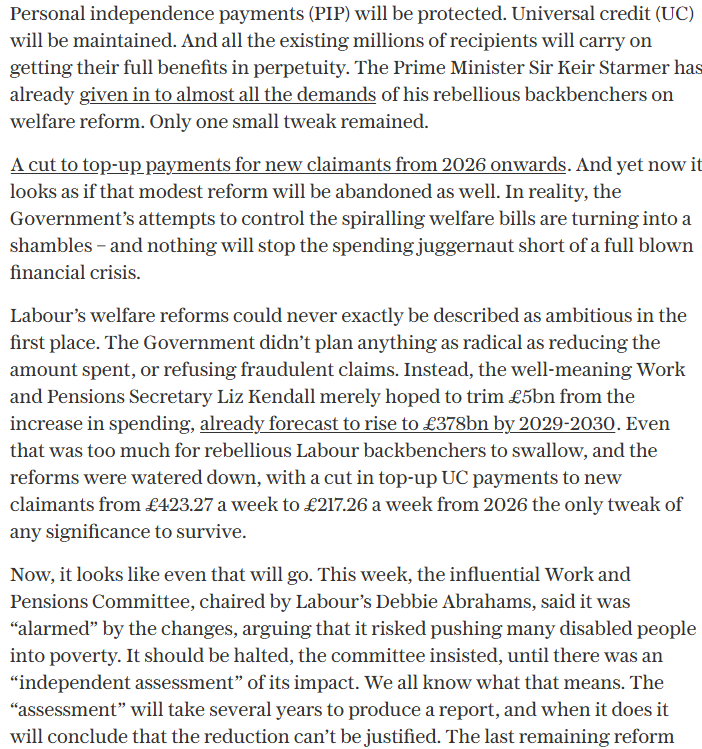
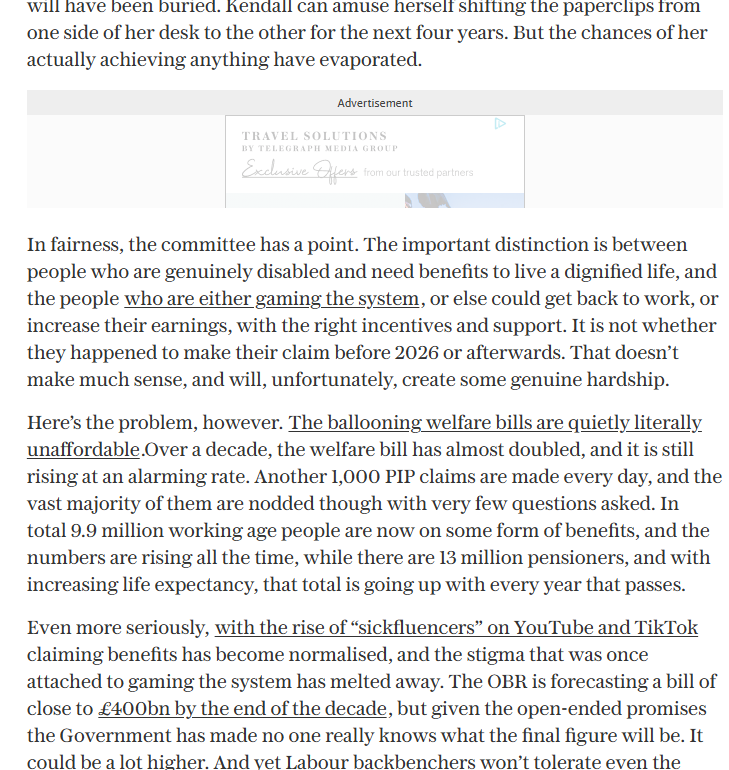
 3
3 -
Catherine you don't need to use an app for UC, it's all done through your Internet browser, which you can use on your phone, tablet and PC. When you get your migration notice you can ask CAB and/or your council welfare team/office to help you with the whole thing, if you don't feel confident doing it by yourself.
0 -
If can type on here like you have nothing to worry about. . No app it's government website on browser
1 -
I really hope it's true that they'll drop the planned cuts to LCWRA.
2 -
how credible is the article? Is it set in stone? Or hear say? Has anything else been said to back it up?
1 -
I thought that starmer and his cronies had dropped the cuts the health part of uc till 2026, till the report from his headhunter timms is finished. Who knows when that'll be.
0 -
It feels to me like it's the Torygraph taking a swipe at Starmer and his cabinet, implying that the select committee's intervention ultimately carries more weight and authority regarding the cuts than the government does. How true that is I couldn't say, but perhaps the writer of that opinion piece knows how these things work in practice. Or maybe they're just being dramatic 🙄
1 -
What is John pring and Amy where else? I'm baffled!
0 -
From the Benefits and Work site
No genuine co-production for Timms review
Published: 04 August 2025
The promised genuine co-production of the Timms personal independence payment (PIP) review already seems to have been ruled out by disability minister Stephen Timms. Timms gave more details of the process in an interview with the BBC last week covering both the PIP review and the forthcoming white paper.
PIP review
It already seems clear that any possibility of genuine co-production of the Timms review with disabled people has been dropped.
Timms told the BBC that his idea of “co-production” is that: “we are going to be taking a lead from disabled people and representatives of disabled people in this work over the next year or so. And what we’re actually doing over the summer we’re going to be planning in detail how that process will be taken forward. What I envisage is there will be a fairly small group of ten people, something like that, who will work very closely with me as the minister for the period of this review, and they will have a lot of say and a lot of sway over the form that the recommendations emerge in.”
This, however, is a very long way from the amendment to the Universal Credit Bill proposed but subsequently withdrawn by MP Dr Marie Tidball MP, following assurances from Timms in the committee of the full house debate.
At column 1045 Timms called the amendment “a helpful checklist of the desirable features of our co-produced review”.
However, there is no indication that Timms intends to follow most of the items on that checklist, including:
The Secretary of State must establish a Disability Co-Production Taskforce (“the Taskforce”) to provide independent oversight of the conduct of the review and the preparation of the final report . . .
The Taskforce must—
(a)be provided with support by the Government Equalities Office,
(b)be chaired by an independent person appointed by the Secretary of State,
(c)have a majority of members who are disabled people or representatives of disabled people’s organisations; and
(d)include such other persons or representatives of such organisations as the chair considers relevant to the effects of the review and proposals developed for the purposes of subsection (3)(a) on disabled people.
Timms cannot in any way be considered to be an “independent person”. He is a government minister who fought hard to remove the PIP daily living allowance from hundreds of thousands of current and future claimants. He should not be chairing the taskforce, even if he is in charge of the review.
Yet Timms already seems to have decided that “the taskforce” will consist of just 10 people and it seems clear that he will make the final decision on who is on that taskforce, rather than those decisions being made by an independent chair.
When asked who was going to be on the taskforce, Timms replied “Well, we haven’t yet worked out who it’s going to be… I’m going to be talking to disability organisations, I mean, I do talk regularly to them of course, but I’ll be talking specifically about this point so that we can set out in the detail both the process and how it’s going to work.”
There is also a lack of clarity about one of the primary aims of the review: is it a cost-cutting exercise?
Timms told the BBC: “The review exercise that we’re undertaking is not designed to deliver spending cuts. I mean, we will certainly have to operate within the current projections for what spending is going to be. . . This review is not intended to deliver cuts. I think it’s quite important that that is well understood because I don’t think some of the people who we need to be involved in the review would be if they thought that that’s what it was for.”
Yet, in her welfare reform speech on 21 May 2025, secretary of state Liz Kendall told MPs that:
“And the number of people on Personal Independence Payments is set to more than double to 4.3 million.
There are now 1,000 new PIP awards every single day. That’s the equivalent of adding a city the size of Leicester every single year.
This is not sustainable or fair – for the people who need support and for taxpayers.
So unless we reform the system to help those who can work to do so…
Unless we get social security spending on a more sustainable footing…
And unless we ensure public money is focused on those with the greatest need and is spent in ways that have the best chance of improving people’s lives…
…the risk is the welfare state won’t be there for people who really need it in future.”
So, are the current projections that the PIP review will have to operate within, the ones that Liz Kendall says are “not sustainable” and, if so, what is the likelihood of Liz Kendall implementing the recommendations of the review?
Or are they the projections which take account of Labour’s original intention to cut £5 billion from the overall welfare benefits budget by 2030?
Whatever the reality, it is clear that the Timms review will be a carefully managed consultation and in no way a co-production in which disabled people have a clear say in what changes the government actually implements.
Five other committees
Timms revealed that five other committees have already begun work. These cover:
- Pathways to Work
- Right to Try
- Access to Work
- Raising the age at which people can claim PIP to 18
- Delaying access to the UC health element until age 22
There are approximately 10 people on each committee, all of whom are currently operating under a cloak of anonymity. They have all met once and will meet every month for two or three hours until October, when their recommendations will be presented to ministers and “will be very influential in the final decisions that get made.”
This means that each committee will have met a maximum of four times for a combined total of between 8 and 12 hours, before making recommendations that will affect the future of potentially millions of claimants.
No committees
There did not appear to be any mention of a committee to discuss the proposed new Unemployment Insurance contributory benefit, which was consulted on in the Pathways to Work Green Paper.
Nor was there any mention of a committee to consider the scrapping of the WCA, which was set out in the Green Paper, but on which there were no consultation questions. Timms has said, however, in his PIP review terms of reference that “We will be setting out plans for how access to the health element of UC will work when the WCA is removed as part of the forthcoming White Paper.”
No confidence
It is hard to take an optimistic view of the consultation processes taking place.
The fact that existing committees are operating anonymously, without any public information about their terms of reference or procedures, does not encourage confidence. Clearly individuals may not wish to be identified, but there seems no reason why organisations should not be.
And the lack of any real element of co-production in relation to the Timms review suggests that it will be little more than a cover for whatever it is that the DWP plan to do anyway.
You can listen to the BBC programme Access All here.
https://www.benefitsandwork.co.uk/news/no-genuine-co-production-for-timms-review
0 -
The user and all related content has been deleted.2
-
The user and all related content has been deleted.4
-
For some time i have been saying on here that the DWP has declared war on us disabled people.In the past my comments have often been removed by censors,which i do understand.However,nothing that has happened in the last few months has served to persuade me that i was wrong with my original assertion.I maintain that the DWP has set out to make things as difficult as possible for us.
After years of having to deal with these miscreants,my over-riding feelings are sadness and frustration.I,and many others,are often treated with contempt and hostility.I ask the rhetorical question…"How have things been allowed to become so bad?.."
2 -
jw68, miscreants is the right word for them.
I'm 100% persuaded that nothing has changed since I claimed Incapacity Benefits in 2006. DWP has knowingly put me at risk of harm and homelessness by denying my rightful entitlement ever since! I've told them I'm just waiting to retire so they'll leave me alone. They have no intention of leaving me alone just yet though 😔
I have identified what I believe is the root of the scam which is a 'Correction Slip' inserted into the ESA regs by IDS in June 2011 which was carried into the 2012 Welfare Reform Act unscrutinised and unchallenged.
It didn't correct anything; it corrupted the ESA regs. It was a corruption slip. I've tried and tried to explain it on this forum but members still believe it was so long ago that it no longer matters. It does.
In 2015, IDS suddenly spotted "a fundamental flaw in the regulations", new cuts were agreed and ESA was further corrupted by the removal of reg 29 -(2)(b) - exceptional circumstances - from the WCA process. That was the Welfare Reform and Work Act 2016.
Reg 35 -(2)(a)b) under Part 6 of the ESA regulations is the equivalent of reg 29 -(2)b) under Part 5.
In 2008, there was a Work-Related Activity Assessment (WRAAt) (Part 6) and a Work Capability Assessment (WCA) (Part 5) to determine eligibility for an award - in that order.
2 -
I wonder if any of this will be/can be legally challenged? It doesn't seem that the government is being very transparent regarding the Timms review.
0 -
Thanks for highlighting this.I honestly did not know anything about it.I guess it just shows what we are up against,regarding the DWP and their dirty tricks.
0 -
Agree Catherine. This Timms review is a face saving exercise of the government.
2 -
The user and all related content has been deleted.1
-
jw68, miscreants is the right word for them.
I'm 100% persuaded that nothing has changed since I claimed Incapacity Benefits in 2006. DWP has knowingly put me at risk of harm and homelessness by denying my rightful entitlement ever since! I've told them I'm just waiting to retire so they'll leave me alone. They have no intention of leaving me alone just yet though 😔
I have identified what I believe is the root of the scam which is a 'Correction Slip' inserted into the ESA regs by IDS in June 2011 which was carried into the 2012 Welfare Reform Act unscrutinised and unchallenged.
It didn't correct anything; it corrupted the ESA regs. It was a corruption slip. I've tried and tried to explain it on this forum but members still believe it was so long ago that it no longer matters. It does.
In 2015, IDS suddenly spotted "a fundamental flaw in the regulations", new cuts were agreed and ESA was further corrupted by the removal of reg 29 -(2)(b) - exceptional circumstances - from the WCA process. That was the Welfare Reform and Work Act 2016.
Reg 35 -(2)(a)b) under Part 6 of the ESA regulations is the equivalent of reg 29 -(2)b) under Part 5.
In 2008, there was a Work-Related Activity Assessment (WRAAt) (Part 6) and a Work Capability Assessment (WCA) (Part 5) to determine eligibility for an award - in that order.
2 -
Morning @Catherine21 it's been a lot recently hasn't it. I hope you're ok. Getting out might help a little (although the Dentist doesn't sound too fun😅). Maybe pop and treat yourself to a coffee and cake beforehand just to help take your mind off things if you can. 💛
1





Categories
- All Categories
- 16.4K Start here and say hello!
- 7.8K Coffee lounge
- 123 Games den
- 1.8K People power
- 189 Announcements and information
- 25.9K Talk about life
- 6.2K Everyday life
- 444 Current affairs
- 2.6K Families and carers
- 889 Education and skills
- 2K Work
- 630 Money and bills
- 3.8K Housing and independent living
- 1.2K Transport and travel
- 674 Relationships
- 1.6K Mental health and wellbeing
- 2.6K Talk about your impairment
- 885 Rare, invisible, & undiagnosed conditions
- 950 Neurological impairments and pain
- 2.3K Cerebral Palsy Network
- 1.3K Autism and neurodiversity
- 41.8K Talk about your benefits
- 6.2K Employment & Support Allowance (ESA)
- 20.6K PIP, DLA, ADP & AA
- 9.5K Universal Credit (UC)
- 5.4K Benefits and income