Do you have problems processing the sounds your ears hear

Many can have problems with their brain processing the sounds that their ears hear, this can be a genetic issues and is an Auditory Processing Disorder (which is a life long set of issues and symptoms which can include developmental dyslexia), and there are acquired causes such as brain injury, stroke, and dementia and can be part of the various types of Aphasia, Auditory Agnosia and including Acquired Dyslexia also known as Alexia.
Currently there is a lack of UK medical and support professionals who are adequately trained and qualified to assess , diagnose and provide the support that those of us who may have these issues on a life long basis.
I have a clinical diagnosis of having the Temporal type of Auditory Processing Disorder, my brain having problems processing the gaps between sounds, which can include the gaps between words in rapid speech, unable to process and understand conversations as they happen, word recall problems and poor auditory memory. My Auditory Processing Disorder is the underlying cognitive cause of my dyslexia symptom.
Hopefully all UK Audiologists will soon be adequately trained and qualified to provide the understand and support those of us who have these issues and also will be able to work as part of a support team with UK Speech and Language Pathologists ( who call these issues a Specific Language Impairment (SLI) and are marketing a new name Developmental Language Disorder) and Psychologists who currently claim to diagnose the dyslexia symptom.
Comments
-
I Tried to share this point with a Neuro psychiatrist and recently with my GP But will try again. There is more than one part of my brain that struggles to process both audio and words. WIith audio it's certain frequencies. Those frequencies which would have at one time been heard 'normally ' I guess sound like a blackboArd being scratched and I have an involuntary withdrawal response to them. The other processing issue is language. Quite simply put the longer someone talks for the more disturbing it becomes to me. Words. JUmble together, sounds become tangled, the whole thing gets too much and I shut down. I suffer with non-epileptic seizures and have been trying to explain that my triggers are current (not past) and are auditory. I have even talked about being referred to a neuro - audio logist for special ear plugs but haven't met anyone advanced enough to even grasp what I'm dscribing. YEt...I love in hope.1
-
Hi @LaughingLolly
I have an Evernote web page where i have listed some recent international Auditory Processing Disorder research, which is listed country by country "Some International Auditory Processing Disorder Research Papers" I hope this helps,
I helped the UK Medical Research Council run a 5 year Auditory Processing Disorder research program 2004 -2009, and helped run the support organisation they required to get government funding for their research program.
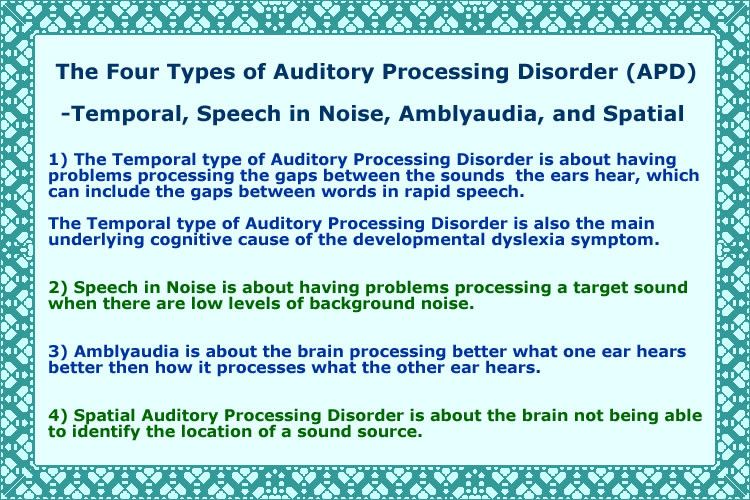
There are currently 4 different types of Auditory Processing Disorder, there could well be more as research improve our understanding of these complex issues.
1 -
-
 1
1 -
Im trying to umdesrstand this i have dyslexia and ive just recently been diagmosed with cptsd which really shocked me tbh whats the link pls and as i get older everything gets worse with retain information writing im getting so overwelmed makes me feel sick
0 -
Ps mines light as well i always wear sunglasses or am in a dark room
0 -
I found this on Google
What is Complex Posttraumatic Stress Disorder (C-PTSD)?
C-PTSD is a mental health condition that also may be diagnosed by a professional when someone has experienced a traumatic event. C-PTSD shares many symptoms in common with PTSD, including re-experiencing, avoidance, and hyperarousal, as described above. However, C-PTSD also includes
- Problems in emotion regulation, like having difficulty managing ones feelings
- Problems in self-image, like feeling completely different from other people and/or having a negative self-view
- Interpersonal problems, including having trouble trusting others
I am dyslexic, and the Temporal type of Auditory Processing Disorder is the underlying cognitive cause of my dyslexia symptom
My brain has problems processing processing and identifying the gaps between the sounds my ears hear the assessment test is the Random Gap Detection Test which attempts to measure the size of ga between the sounds the ears hear, the brain is able to process and identify. When I did the test in 2003 it did not include a gap large enough for me to identify, which explained my problems processing rapid speech which to me is one continuous noise and it explained my dyslexia as I am cognitively not able to use phonics.
There are three possible causes of the dyslexia symptom :- Auditory Processing Disorder, and or Visual Processing Disorder, and or Attention Deficit Disorder (which is part of ADHD)
And like me you may experience some trauma when others do not communicate to match how you are best able to process what they are talking about or explain using text
0 -
"Ps mines light as well i always wear sunglasses or am in a dark room"
You may need to be assessed by an Optometrist to assess your visual processing issues
0 -
Oh ok Thankyou i will look that up Thankyou for all your posts really eye opening for me
1 -
Sorry to go on when im writing a post i just write as i talk if that makes sense its like one long sentence no capital letters full stops i have no idea where they belong still at this age its like my brain wont activate to learn or asorb information i see other people who are dyslexic cope with learning honestly at one point i thought i had some form of damage to my brain its very distressing i remember i used to bunk off school as i used to look at everyone head down engaging with teacher and understanding the essays this goes back from as young as three
0 -
I worked out years after my APD diagnosis that my parents had paid for me to go to a private school so that they could tell them about my limitations as they and previous generations of my family all had similar lifelong limitations. But they always tried to hide them.
Most of the problems came from my peers, who considered me to thick or stupid. I was just different to them and what they expected.
I was placed at the back of one class and i found out this was so that i would not be asked to read aloud during lessons when i was 7- 8 years old. i still had teachers who did nor understand my limitations, and alternative strengths.
I was no good at exams and tests, I would have problems working out the full meaning of the questions, and then remembering the words I needed to use in my answers, I sometimes cold not remember what my home work was, so I failed to do it which caused problems with the teachers.
Some of the underlying causes of these cognitive limitations can be genetic issues, some can be due to the brain reacting to various illnesses, and some can be caused by brain injury. International research has been explaining this during the last few decades.
0 -
Hi @Catherine21 - to find out if you may have a 'visual processing disorder,' a Behavioural Optometrist (an Optometrist who has undertaken extra accreditated training) may be able to help. Unfortunately they're not available through the NHS.
There's a little info here:
As they say, they often see patients with dyslexia for example, as a comorbidity.
1 -
Thankyou im learning so much sort of bitter sweet really a whole life of punishing myself i can see this and so many other conditions all tied in and its so sad as is it any better for young kids now ? Hurts to think especially as not on the nhs
0 -
Awfuk isnt it tbh until i joined scope i avoided anything to do with writing or engaging in group talk for years ive been isolating for 14 years and as i said before i done thousands of posts oh here and trying to express myself in posts has brought back all my struggles and how bad it really is and how it has really effected my life and with all this pathways to work scheme has brought back the horrendous daily struggle of umderstanding the outside world yes i was put in class for naughty kids labelled slow i masked how to be presentble clean tidy even funny and some have said knowlegable when i speak face to face i dont believe that one funny how we can just cutoff well i did totally avoided my dyslexic brain gosh ive been running all my life no wonder feel drained tiring isnt it
1 -
When I had problems after my bad A Level results I had my first nervous breakdown in my teens, and again when I was unable to complete my HND Business course. I was not able to provide the required Extended Essay the explain a topic in some great detail
During this time I was diagnosed as having a Personality Disorder, my family did not tell me what I had been diagnosed with. I only found out when I was looking at my NHS Medical History in recent years.
I now know that back in the 1970s that here in the UK there was no Medical Knowledge regarding my lifelong disability Auditory Processing Disorder, nor was there any great awareness of dyslexia.
So back then what was described in my case as a Personality Disorder was in reality Auditory Processing Disorder.
My lifelong problems processing the sounds that i hear includes speech, and i can have problems processing and understanding what a person may be saying a conversation. And due to my poor auditory memory I can forget a conversation as soon as i leave the room where I had a conversation. Sometimes this happens when I go to see my GP I know what I said, as I prepare that before my appointment but I can forget what the GP has said.
I need to have visual notes via email from my GP to remind me what had been explained during my appointment. So that i can read the contents of the email in my own time more than once, and look up the meaning of any new to me terminology online at Google, Wikipedia, and or PubMed.
When I was running the APDUK support organisation , especially the web site I discovered that from birth I had become a visual spatial learner to work around my APD. I was working with the Medical Research Councils APD researcher team, and they began to send me copies of their research papers. it took me 3 months to read the first one, as I tried verbalise the new to me terminology, Then I started to just visually read the research papers and not trying to verbalise them. As result of this I discovered that I can visually speed read research papers, but I am not verbally able to pronounce the new to me terminology, I have to have someone repeated say the new word until I can verbally pronounce it correctly.
There some Brain Development and Maturation research papers that explain during the early stages of brain development birth to 7 years old the various arras of the brain develop at different timed and different rates in each individual. And the brain later begins to develop alternative compensating skills and abilities using an individuals personal cognitive strengths to work around their personal cognitive limitations.
0 -
Wow yes i was diagnosed with bpd in 2010 i have trouble with certain words my daughter used to laugh not in a bad way id make a joke of it how you managed to deal with this is amazing but for me personally at 54 i think its inbedded in me
0 -
With all due respect @dolfrog - if anything, then likely @Catherine21 is suffering from a visual processing disorder. I have wondered if this might be the case about yourself too due to the problems you identify.; have you considered this?
0 -
There are three possible causes of the dyslexia symptom, the main underlying cognitive cause is the Temporal type of Auditory Processing Disorder, which includes the brain having problems processing and identifying the gaps between the sounds the ears hear, what the out of date dyslexia industry calls a phonological awareness deficit. The other possible causes of the dyslexia symptom are Visual Processing Disorder, and Attention Deficit Disorder (which is part of ADHD).
Dyslexics can have one or more of the underlying cognitive cause(s) of their dyslexia symptom.
I found out after my Auditory Processing Disorder diagnosis in 2003 when I was 49, at Sheffield University, that I had become a Visual Spatial Learner using my visual cognitive strengths. So I do not have a visual processing disorder, I think in pictures, diagrams, charts, and practical demonstrations.
International Brain Development and Maturation research has explained that during and after the first stage of human brain development, birth to the age of 7 years old, the human brain develops alternative compensating skills and abilities to work around their lifelong cognitive limitations.
0 -
Some of my PubMed research paper collections regarding Auditory Processing Disorder which
are listed on one of my Bookmax web pages.
and the link to my Auditory Processing collection is
https://public.bookmax.net/users/dolfrog/bookmarks/1271172
My PubMed “Auditory Processing Disorder” research paper collectionMy PubMed “Amblyaudia” research paper collection
My PubMed "Auditory Processing in Background Noise" research paper
collectionMy PubMed "Auditory Spatial Awareness" research paper collection
My PubMed "Auditory Temporal Processing" research paper collection
My PubMed "Auditory Gap Detection" research paper collection
My PubMed "Auditory Perception" research paper collection
My PubMed “Auditory Memory” research paper collection
My PubMed "AudioVisual Integration" research paper collection
My PubMed "Auditory Processing and Specific Language Impairment"
research paper collectionMy PubMed "Auditory Processing and Developmental Dyslexia" research
paper collectionMy PubMed "Auditory Processing and Working Memory" research paper collection
My PubMed “Brain Development and Maturation” research paper collection
There are more but these are the main ones
0 -
Just a correction for my typing error in the above comment
My Bookmax listed research paper collections
0


Categories
- All Categories
- 15.8K Start here and say hello!
- 7.6K Coffee lounge
- 106 Games den
- 1.8K People power
- 161 Announcements and information
- 25.3K Talk about life
- 6.2K Everyday life
- 511 Current affairs
- 2.5K Families and carers
- 874 Education and skills
- 2K Work
- 581 Money and bills
- 3.7K Housing and independent living
- 1.2K Transport and travel
- 644 Relationships
- 1.6K Mental health and wellbeing
- 2.5K Talk about your impairment
- 881 Rare, invisible, & undiagnosed conditions
- 941 Neurological impairments and pain
- 2.2K Cerebral Palsy Network
- 1.3K Autism and neurodiversity
- 40.8K Talk about your benefits
- 6.1K Employment & Support Allowance (ESA)
- 20.3K PIP, DLA, ADP & AA
- 9.1K Universal Credit (UC)
- 5.3K Benefits and income