Hope for a different future - a chat with Lesley about feelings of grief when your child is disabled

Tori_Scope
Scope Posts: 12,471 Championing
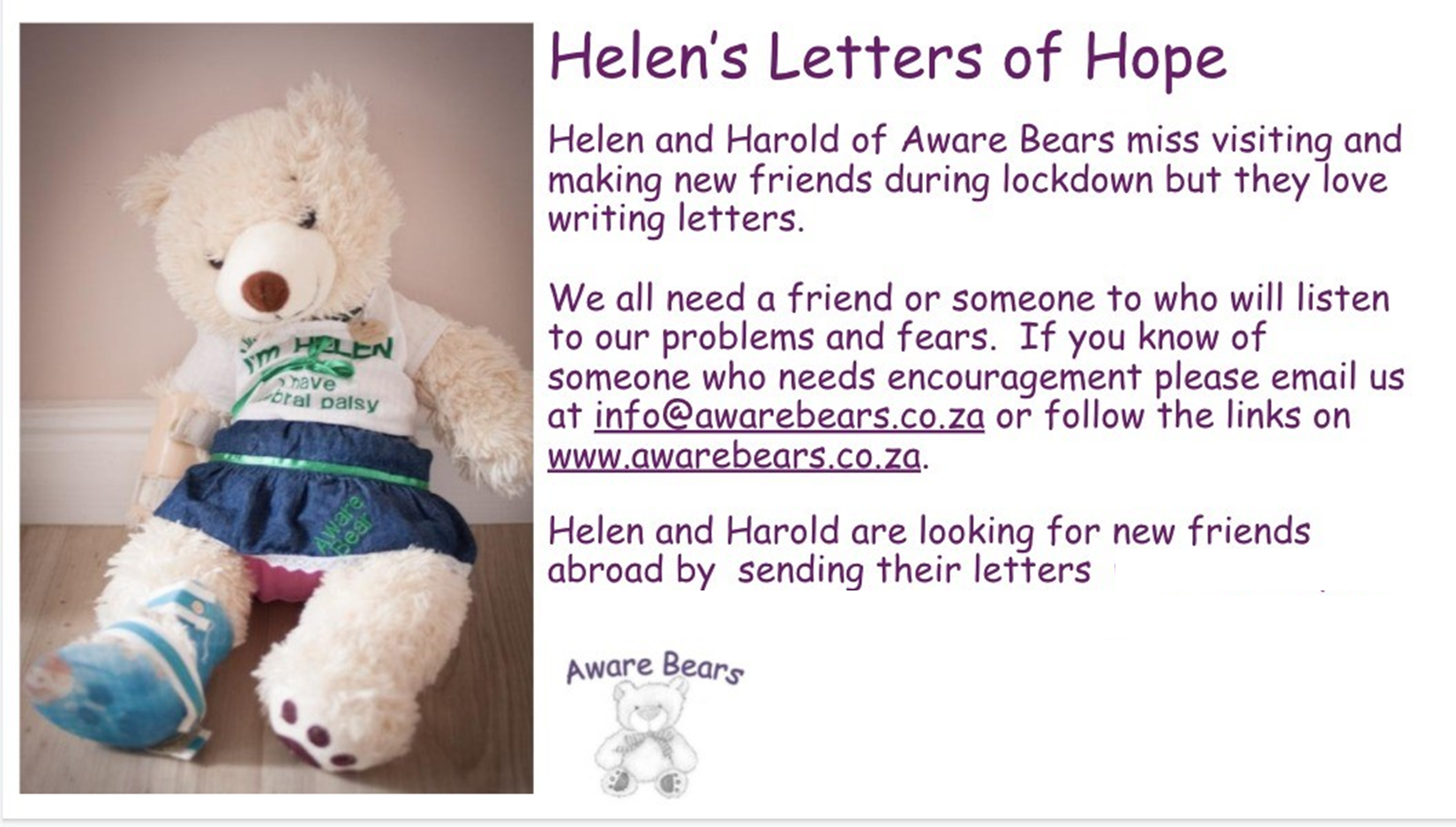
Aware Bears is a cerebral palsy (CP) awareness programme supporting people with CP and their families in South Africa.
Lesley from Aware Bears has kindly written the following post about experiencing feelings of grief when you have a disabled child. Give it a read, and let us know what you think in the comments!
Have you faced judgement or awkwardness from others if you have a disabled child?
Do you think that being the parent of a disabled child helped you to have the skills to deal with the lockdowns imposed due to the coronavirus pandemic?
Lesley from Aware Bears has kindly written the following post about experiencing feelings of grief when you have a disabled child. Give it a read, and let us know what you think in the comments!
Grief is an emotion we all feel but seldom acknowledge. It is an emotion shrouded in darkness,
living in the shadows, lingering, breathing.
When a parent is told that their beautiful newborn will live a different life to the one that they had imagined, the first feeling is numbness, shock.
All the hopes and dreams a new parent carries for the future is suddenly altered irrevocably.
Those parenting books and articles that were previously read with great enthusiasm no longer apply. The future is now unclear. Uncertainty hovers.
Fear and grief is their new companion and confidant, the road before them an uncharted one.
Each family has their own path to travel and while their diagnosis may be the same, the support and understanding of those around them is not.
All the milestones that were initially met with great enthusiasm are now altered and replaced with hesitancy and trepidation.
Social situations which were once anticipated with enthusiasm must now be meticulously planned and arranged, or avoided altogether.
It's the awkward silences of others which makes one sink further into silence, isolation, then grief.
The inability to accurately describe the full range of emotions that is experienced having had your child diagnosed, sets an invisible boundary that is seldom crossed by those who do not live through the same experiences.
One feels the need to constantly explain to others while, in truth, there should be no explanation required, because each child is uniquely beautiful -differently abled or not.
Unfortunately, we do not live in that idyllic world where no explanations are required. It's the feeling that one will somehow be judged that keeps parents silent.
Many choose to live their rich, beautiful lives behind closed doors.
Society is often ill equipped to deal with the issues that some are forced to face and, rather than subject their child and themselves to the judgements of others, parents remain detached - not because they want to be, but rather as a protective shield for their child.
Sometimes the nature of grief is that not every parent has the capacity to challenge the injustices that their children face on a daily basis. They somehow feel that their inability to do so is letting their child down, when in truth, they are doing the best they can within their circumstances and control.
During the past two years of forced isolation, the world has been living in unprecedented times. Grief and loss have now come to the forefront of many lives. It has altered how we've had to interact and socialize. It has pushed many to the brink of despair.
That is, except for a select group who, unbeknownst to themselves, have subtly gained the skills others have not, because of what they have had to contend with in their everyday lives.
Parents of differently abled children and their families have learnt to adapt, work within the boundaries laid out for them and find joy and happiness in the unexpected moments. Many have unwittingly gained the skills that others over the past two years have only begun to experience. Perhaps it is time that parents of differently abled children step out of the shadows and into the limelight.
Those now having to embark on a new and unsettled future for the first time, must first grieve the life they thought they would live. Only then may they be able to embrace the one laid out before them.
Being willing to admit that our frailties may in fact be our strongest ally, could be perceived as a little far fetched and unrealistic, but if we are to move forward, a linear approach could in fact be the opposite of what is required.
Some may argue that it is naive to believe that in the new world we now live in, there is an opportunity for us to re-examine the true meaning of the concepts “differently abled” and ” inclusivity” and the stigmas that surround them, having experienced isolation in one form or another. In the future, perhaps concerted efforts will be made in addressing what for others is the norm.
When a parent is told that their beautiful newborn will live a different life to the one that they had imagined, the first feeling is numbness, shock.
All the hopes and dreams a new parent carries for the future is suddenly altered irrevocably.
Those parenting books and articles that were previously read with great enthusiasm no longer apply. The future is now unclear. Uncertainty hovers.
Fear and grief is their new companion and confidant, the road before them an uncharted one.
Each family has their own path to travel and while their diagnosis may be the same, the support and understanding of those around them is not.
All the milestones that were initially met with great enthusiasm are now altered and replaced with hesitancy and trepidation.
Social situations which were once anticipated with enthusiasm must now be meticulously planned and arranged, or avoided altogether.
It's the awkward silences of others which makes one sink further into silence, isolation, then grief.
The inability to accurately describe the full range of emotions that is experienced having had your child diagnosed, sets an invisible boundary that is seldom crossed by those who do not live through the same experiences.
One feels the need to constantly explain to others while, in truth, there should be no explanation required, because each child is uniquely beautiful -differently abled or not.
Unfortunately, we do not live in that idyllic world where no explanations are required. It's the feeling that one will somehow be judged that keeps parents silent.
Many choose to live their rich, beautiful lives behind closed doors.
Society is often ill equipped to deal with the issues that some are forced to face and, rather than subject their child and themselves to the judgements of others, parents remain detached - not because they want to be, but rather as a protective shield for their child.
Sometimes the nature of grief is that not every parent has the capacity to challenge the injustices that their children face on a daily basis. They somehow feel that their inability to do so is letting their child down, when in truth, they are doing the best they can within their circumstances and control.
During the past two years of forced isolation, the world has been living in unprecedented times. Grief and loss have now come to the forefront of many lives. It has altered how we've had to interact and socialize. It has pushed many to the brink of despair.
That is, except for a select group who, unbeknownst to themselves, have subtly gained the skills others have not, because of what they have had to contend with in their everyday lives.
Parents of differently abled children and their families have learnt to adapt, work within the boundaries laid out for them and find joy and happiness in the unexpected moments. Many have unwittingly gained the skills that others over the past two years have only begun to experience. Perhaps it is time that parents of differently abled children step out of the shadows and into the limelight.
Those now having to embark on a new and unsettled future for the first time, must first grieve the life they thought they would live. Only then may they be able to embrace the one laid out before them.
Being willing to admit that our frailties may in fact be our strongest ally, could be perceived as a little far fetched and unrealistic, but if we are to move forward, a linear approach could in fact be the opposite of what is required.
Some may argue that it is naive to believe that in the new world we now live in, there is an opportunity for us to re-examine the true meaning of the concepts “differently abled” and ” inclusivity” and the stigmas that surround them, having experienced isolation in one form or another. In the future, perhaps concerted efforts will be made in addressing what for others is the norm.
Over to you...
Can you relate to the feelings that Lesley has touched on in her post?Have you faced judgement or awkwardness from others if you have a disabled child?
Do you think that being the parent of a disabled child helped you to have the skills to deal with the lockdowns imposed due to the coronavirus pandemic?
1
Comments
-
Hmm...I am parent of 24 year old with significant quad athetoid CP and whilst i can identify with quite a lot of this it's not really written in a way that works for me.I don't think they are actually parents of someone with CP (I just read the webpage) rather at least Helen has CP. So the perspective is not a parents one; though I do not doubt they have spoken to many.It does read a bit as if every parent will feel all the things they describe; but we don't...it's much more complex than that. For instance cos initially we were told very little (first 2 hours) we imagined that he was dead...but he wasn't...so anything after that was a bonus!Similarly, i found breastfeeding him very challenging for the first 9 weeks and so that actually served to ease me into the whole disabled baby thing! It focused my mind and when it succeeded eventually, I felt really rewarded.I also know that there are some in the wider CP community here who really struggle with the concept of grief as an emotion when a baby has CP.I do understand though that it is basically how some parents feel, just not how i felt.And to talk about 2 years of lockdown as a chance for the non-disabled world to get an idea how we as parents of disabled kids/adults feel all the time just seems a bit bizarre to me.The lockdown was terrible for many of us as we had to manage with little or no outside support for months/years...but i don't see how that relates to the lives of the rest of the population during lockdowns.. it seems to be veering towards the "heroic parents" thing, which personally I really struggle with.Sorry, you did ask!0
-
Thanks for sharing @forgoodnesssake
 I also found your comment interesting to read! I'm not the parent of a disabled child (or any child for that matter!), so I can't pretend to know what it's like. As you've said, I imagine it's very different for different people. 0

Categories
- All Categories
- 16.1K Start here and say hello!
- 7.5K Coffee lounge
- 116 Games den
- 1.8K People power
- 165 Announcements and information
- 25.4K Talk about life
- 6.1K Everyday life
- 396 Current affairs
- 2.5K Families and carers
- 882 Education and skills
- 2K Work
- 594 Money and bills
- 3.8K Housing and independent living
- 1.2K Transport and travel
- 660 Relationships
- 1.6K Mental health and wellbeing
- 2.5K Talk about your impairment
- 882 Rare, invisible, & undiagnosed conditions
- 943 Neurological impairments and pain
- 2.3K Cerebral Palsy Network
- 1.3K Autism and neurodiversity
- 41.2K Talk about your benefits
- 6.2K Employment & Support Allowance (ESA)
- 20.4K PIP, DLA, ADP & AA
- 9.3K Universal Credit (UC)
- 5.3K Benefits and income