Reporting capital monthly (giving advice)

Hello,
I have always had some confusion regarding reporting capital. If you have over 6k in your bank accounts you will need to report everyday on the last day of your assessment period the amount. I've never really seen a clear explanation for how to do this, so following a recent review I asked if they could make me a worksheet to follow. In this the claim review team stated in order to correctly be getting the right amount every every month I should:
1. Add up all the money in all my bank accounts
2. Minus the PIP amount I received that month (If you received two during the assessment period it doesn't matter you only report one)
3. Minus all cost of livings payments received if you haven't spent them (my account never went under after I received them so they aren't counted as spent) (this may change in the future but currently they are deductible)
4. Upload the final figure (they said not to bother reporting my accounts separately as it can get confusing and this is the best possible practise to make sure the figure being reported is correct)
I followed these rules this month and asked them to respond if the figure was right and I had done everything correctly and they said that it was.
Hopefully, this can help anyone else who is confused about reporting their monthly capital and making sure they are getting the right deductions.
I can't speak on any other deductions you may be entitled to as these are the only benefits I receive.
You may want to check on your journal which cost of living payments you have aren't counted as spent just to make sure you are making the right deductions.
You may also want to inform on your journal that this is how you will be reporting your capital going forward just to make sure the person that handles your case is aware.
Comments
-
Thank you for this. That is very interesting and quite different to the way I've been doing it myself.
(I did ask in the journal more than once whether I was doing it correctly and never got a reply).
I am surprised they told you not to separate accounts when reporting, as that's currently the longest part of the process for me.
1 -
Thanks for sharing this @needhelp120 ☺️
0 -
I think that was just worded ambiguously.
The COL's stop being deducted if total capital drops below the amount of the COL's, not below £6k.
1 -
2. Minus the PIP amount I received that month (If you received two during the assessment period, it doesn't matter—you only report one)”. Sounds very strange.
People usually receive some type of income twice during an assessment period (wages, benefits, etc.), and for UC, these monies count as income/capital. People are usually not allowed to deduct something.0 -
PIP is paid 4 weekly. So just once a year there will be two PIP payments during one UC calendar month AP.
PIP is counted as income, not capital, during the first period in which it's paid. So technically it should be deducted. But it is a grey area, because the claimant could have spent half their PIP by the time they have to declare capital to UC.
0 -
@OverlyAnxious A person cannot deduct one PIP payment or other income received during an assessment period solely on the basis that ‘this type of income was received more than once during the assessment period’. UC looks only at a person’s capital on the last day of the assessment period, regardless of the income the person received during the assessment period. So there is no official law that allows this, and if any claimant, during a capital declaration, self-deducts a second PIP payment, Carer’s Allowance, wages, etc. during one assessment period, this may lead to sanctions because the claimant has declared an incorrect capital amount. UC staff very often give incorrect advice, and the best idea is to always ask for a written explanation to avoid any problems in the future.
In certain circumstances, a decision maker can transfer one payment into the next assessment period. However, this is more related to a person’s wages, when a person receives wages twice during one assessment period and then receives no wages at all during the next period.
0 -
It sounds like you are agreeing with what the OP wrote and what I wrote. Only one PIP payment can be deducted during a single AP, not two.
The review staff do not actually complete the reviews 'correctly' in my opinion. If it went to court because they closed someone's account for having over £16k, then it turned out that £500 of that was income from PIP, they would be in breach of their own rules around the difference between income and capital.
Problem is that the actual calculation is incredibly difficult. Because it means subtracting every piece of expenditure from income to leave only the unspent income which should be deducted from the capital calculation. It would take too long for the staff to do that, and in cases such as this where PIP and UC don't align due to the difference in periods being 4 weekly and calendar monthly, it's virtually impossible to work out expenditure from different payments.
Technically they should not be including unspent UC income either. Even the .Gov website explains this. Income does not count as capital until the end of the AP following the one in which it is paid. However, due to the complexity of the calculation, the review staff do not deduct any UC (which has been proven with screenshots from their computer systems). That is also incorrect, and again, if it went to court for closing a claim due to passing £16k, they would find themselves in breach of their own rules.
Universal Credit: money, savings and investments - GOV.UK
Income
Your income is counted as savings if it has not been spent by the end of the assessment period after the one in which it was received.
Example
Katie’s assessment period for Universal Credit runs from the 8th of the month to the 7th of the next month.
Katie was paid a salary of £2,000 on 1 April. This was within her 8 March to 7 April assessment period.
By the end of her next assessment period (8 April to 7 May), she has spent £1,500 of this income.
For the next assessment period (8 May to 7 June) she should report the saved £500 as part of her savings.Tax refunds (known as tax rebates) and National Insurance contribution repayments are counted as income.
0 -
@OverlyAnxious Claimants must report their actual capital and should not self-deduct payments such as PIP, wages, or other income when declaring capital. UC capital is based on the actual amount of money and assets held at the relevant time, not on calculations that remove specific payments received during an assessment period. While unspent income can become part of capital in a later assessment period, this is not something claimants manually adjust by subtracting individual payments when reporting their capital figure. The GOV.UK guidance refers to when unspent income becomes capital over time, not to deducting specific payments from a capital declaration.
0 -
I'm afraid you are mistaken there.
Capital isn't simply all of the money that the claimant has access to. Income is completely separate to capital and should not be included in a capital declaration.
Unfortunately the UC computer system just isn't setup to make all of the correct deductions automatically. For example, there is still nowhere to deduct the COL payments, despite myself and others having asked for this to be added to the system for more than 12 months now. For this reason, we have to deduct COL payments ourselves before declaring the capital.
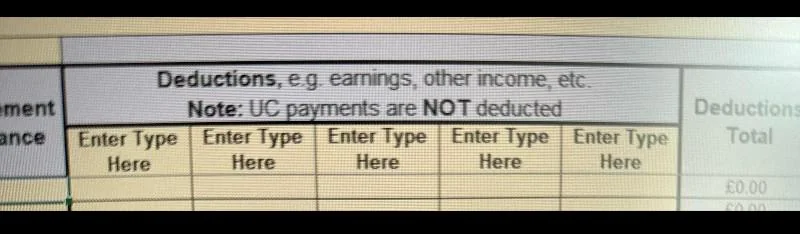
This is a screenshot from a UC Review Team member, showing that other income should be deducted from the overall account total. That does include earnings and PIP, but not UC. This is a compromise to make their job quicker and easier.
 0
0 -
@OverlyAnxious A screenshot from a review team member may show how a particular review was handled, but it is not evidence that all claimants should deduct earnings, PIP, or other income before reporting capital. If there is an official rule allowing these deductions, it should be possible to identify the relevant legislation, regulations, or published DWP guidance. Otherwise, claimants risk reporting a figure that does not reflect the actual capital they hold.
0 -
I'm very confused about this as well. Let's look at the example given by gov.co.uk…
"Katie's assessment period for Universal Credit runs from the 8th of the month to the 7th of the next month.Katie was paid a salary of £2000 on 1st April. This was within her 8 March to 7 April assessment period.
By the end of her next assessment period (8th April to 7th May), she has spent £1500 of her income.
For the next assessment period (8th May to 7th June) she should report the saved £500 as part of her savings."
That's all well and good but what does she do if she's paid a salary on the 1st May?
If she's working then we can assume she'll get one as she did in April. So, let's say it's the same, that means she has saved £500 from the previous salary but her account by the end of the assessment period (ending 7th May) will include her new salary payment of another £2000. So 'totalling up what's left' in her account at this assessment endpoint will be £500 PLUS that new payment.
In order for the 'savings' total to be, as suggested in the example, £500 leftover from the previous income surely she needs to deduct the NEW salary payment which will've arrived in the meantime as it isn't part of that calculation.
The example doesn't reflect a real life situation. Katie is going to have a salary arrive before the end of an assessment period and therefore her account total at that point will conflict with her savings total. I can't see how it can be a case of simply reporting what's unspent in your account at the time of reporting as potentially Katie could have £2500 in there (£500 savings plus the new salary payment).
To me, if I'm right, the example leaves out a crucial step which could be:
"Meanwhile Katie receives another salary payment of £2000 on the 1st May bringing her account total to £2500. She needs to deduct that £2000 from her account total as it does not apply to her 8th March to 1st May assessment period but the next one. Without the £2000, Katie has correctly shown she has spent £1500 of her salary received on the 1st April to leave £500 to report as savings for that assessment period."
I'm typing this while on 200mg Sertraline and 45mg Mirtazapine.
Could anyone please either concur or put me right on this?? Thank you.0


Categories
- All Categories
- 16.4K Start here and say hello!
- 7.8K Coffee lounge
- 123 Games den
- 1.8K People power
- 190 Announcements and information
- 25.9K Talk about life
- 6.2K Everyday life
- 445 Current affairs
- 2.6K Families and carers
- 890 Education and skills
- 2K Work
- 630 Money and bills
- 3.8K Housing and independent living
- 1.2K Transport and travel
- 676 Relationships
- 1.6K Mental health and wellbeing
- 2.6K Talk about your impairment
- 885 Rare, invisible, & undiagnosed conditions
- 950 Neurological impairments and pain
- 2.3K Cerebral Palsy Network
- 1.3K Autism and neurodiversity
- 41.8K Talk about your benefits
- 6.2K Employment & Support Allowance (ESA)
- 20.6K PIP, DLA, ADP & AA
- 9.5K Universal Credit (UC)
- 5.4K Benefits and income