APD

Comments
-
My recent discussions seem to have disappeared regarding Auditory Processing Disorder which is the underlying cognitive cause of my dyslexia symptom.
Does this mean that they have been deleted?
If they have been deleted why? and by whom?
0 -
Last year in September I was asked by my local Mind support group to provide an Auditory Processing Disorder presentation.
To explain the four types of Auditory Processing Disorder, and my clinical diagnosis back in 2003 to help the UK Medical Research Council get government funding for an 5 year research program 2004-2009 run at Nottingham University by Prof. David Moore.
My verbal presentation was based on these pdf notes which are now included on a Google Notes page -
My “Mind” Auditory Processing Disorder Presentation 2025
https://docs.google.com/document/d/12u1UhDDV87TUuLqX4niV_a_4IcjLLlVzptcGjW1aU2k/edit?usp=sharingI have also included the pdf
1 -
Hi @dolfrog
Your post might be caught and suspended in the filter. If so, it will likely reappear (possibly edited) during working hours. If you want to learn more, here is the thread....
0 -
Good morning @dolfrog, the team have sent you a PM about this.
0 -
Well it would appear that I am wasting my time, as they do not want to understand all the aspects of living with Auditory Processing Disorder, and help retrain the so called medical professionals who need to get up to date with international research that explains these complex issues.
1 -
Well from my perspective "Online Safety Act 2023" was created by the UK government of 14 years that did not want to pay to retrain those working UK medical professions and in the UK education system regarding international research that explained many complex invisible disabilities like Auditory Processing Disorder which is the main underlying cognitive cause of mine and many others Dyslexia symptom.
I was the first adult in the UK to be clinically diagnosed as having Auditory Processing Disorder in 2003 to help the UK Medical Research Council get government funding for a 5 year Auditory Processing Disorder research program 2004-2009 run at Nottingham University, they needed someone to set up and run a UK based support organisation to get the funding, i set up and helped run APDUK 2002-2014.
So hopefully those running Scope can get up to date.
1 -
0
-
This is very intreasting i just read up and can relate alot ive learnt so much on here
1 -
0
-
There are four types of Auditory Processing Disorder (APD), the listening disability, the brain having problems processing the sounds that the ears hear.
The Temporal type of APD is about the brain having problems processing and identifying the gaps between sounds the ears hear, problems with auditory memory which can include problems remembering conversations, problems remembering the words needed to use when explaining a topic. The Temporal type of APD is the main underlying cognitive cause of the dyslexia symptom, the brain not being able to process the gaps between the sounds that the letters in a written word represent.
The Speech in Noise type of APD is about the brain having problems processing what some is saying when there are low levels of background noise. Some benefit from low gain hearing aids, and FM Systems. The person doing the talking using a microphone and the loa gain hearing aids receiving the speech or the FM system where ther microphone is connected to a speaker.
The Spatial type of APD is about the brain not being able to locate the source of the sounds the ears hear.
The Amblyaudia type of APD is about the brain only able to process what one ear hears, and not being able to process what the other ear hears.
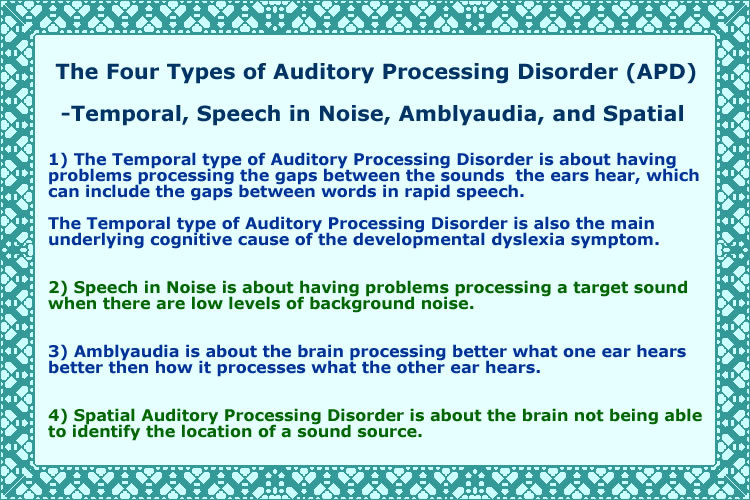 1
1 -
I was clinically diagnosed as having APD in 2003 at Sheffield University the first NHS funded APD research program during the late1990s and early 2000s.
For me the key test was the Random Gap Detection Test which attempts to measure the size of gap between sounds the ears hear, the brain is able to process and identify, When I did the test it did not include a gap between sounds large enough for me to identify.
This explained my problems processing rapid speech as I am not able to process the gaps between words being said, and for me it comes across as one continuous noise. It also explained my dyslexia symptom as I am cognitive not able to use phonics, i need to learn the whole new to me words. I also have problems with verbal instructions
I found out after my diagnosis that I had become a visual spatial learner from birth to work around my lifelong Auditory limitations using my cognitive visual strengths. I think in pictures, graphics, diagrams, charts, and practical demonstrations.
1 -
Mine seems all of this i really really struggle with writing capital letters full stops i just write as im talking i cant retain any information at one point i thougt i had brain damage its impossible for me with listening taking imstructions signs even alaphbet i still cant do it propley everyday seems a new day i cant do something loads of times but i forget how i done it the day before honestly its a real struggle when i was working it was awful as i realy took noting in same with numbers all a muddle
0 -
I have used many Word Processor programs to help me type text.
The one i have most used is Jarte which recently changed by requiring a printer to be connected to my computer, which can be a problem as my computer will not switch on if the printer is left on.
I also now use both Apache OpenOffice and LibreOffice word processors. For me I need to use multiple coloured fonts in a document, and I prefer to use a light blur or light green background colour.
If you have a look at the graphic includes in one of my earlier comments you will see that i start every sentence on a new line, and alternate the colour of the text between green and blue,
If I have to read an article or research paper I copy the text and paste it in a new document on my word processor, and the edit it so that each sentence begins on a new line and then I alternate the colour of the text between green and blue.
Any new words or terminology to me can be highlighted in red, and then i can find an explanation for the word online using Google,, Wikipedia, PubMed, etc. And then I can type an explanation and may be use a different font colour such as brown.
0 -
Thankyou for all thia information i honestly think its to late for me i have run from learning all my life when it was time to do exams at school i hid behind a cabinet and when everyone went into the hall i did a runner very frustrating and extremly embarressing Goodluck today
0 -
Sorry i said goodluck today responding to two posts at same time
0 -
Howdy Dolfrog,
Thanks for sharing more about your experience of APD and your diagnosis. It must have been quite the experience being the first adult in the UK to be clinically diagnosed!
It sounds like you’ve developed lots of strategies to help manage your ADP and it’s good to hear that you’ve found some things that work for you.
I was interested in the mention of 'four types' of APD as I know there is some ongoing debate about how APD is best classified and described. With earlier models, particularly from the US, described multiple subtypes, while recent UK guidance focuses less on fixed “types” and more on individual listening profiles and underlying processing differences.
As APD is a complex area with evolving research and differing professional frameworks, we’re sharing some recognised UK-based sources below so members can explore further information if they wish:
Just to add, we’re not medical professionals, and we don’t allow or provide medical advice here, but we’re always keen to support balanced discussion and help members access reliable information. Thanks again for sharing your story and the strategies that have helped you.
0 -
Hi Carl
When I was clinically diagnosed in 2003 I had been in contact with Prof. David Moore who ran the Medical Research Council's APD research program 2004-2009 for over a year. He came to Hemel Hempstead to meet me and my son, who had been identified as having APD, and the manager of the Hemel disability support organisation.
David Moore worked with me to set up APDUK 2002-2014, providing me with his research papers, and copies of other related research.
[Removed by moderator]
While working with David Moore it took me 3 months to read the first research papers he sent to me. I later discovered that I can visually speed read research papers but I am not able to verbally pronounce the new to me terminology, I found out that I would best guess how to pronounce a new to me word. AT a meeting with David and other researchers at UCL I miss pronounced Hyperacusis, and he whispered the correct pronunciation behind me.
I later found the online USA PubMed research paper library which has over 26 million medical research papers. Those of us who have PubMed accounts are able to create our own online research paper collections at their web site. Currently I have over 130 research paper collections relating to many invisible disabilities and their symptoms., including APD.
1 -
Hi Carl
Me again
The problem with the main USA model is "The Buffalo Method 2004" is that the so called Audiologists do not want to use the Random Gap Detection Test as part of an assessment, and they only want to provide what they claim to be therapy. The Buffalo Method was created by the then leading Audiologist researcher Jack Katz before his retirement.
The reason they do not want to recognise the Random Gap Detection Test is that it if it were to be used in most of the Northern Sates of the USA they would have to explain that the local rapid rate of speech is too fast for those of us who have the Temporal type of APD to process and identify. So they would have to explain to these communities that they need to slow down their rapid rate of speech. I have an online Facebook APD support group which has over 26,000 members many of whom are from the USA. back in 1999 I joined as USA based online (C)APD support group to find out what then known as CAPD was. I found out after 6 months that I had been living with APD all of my life. back in 2017 the owner of the USA group joined my Facebook group and told me that APD has nothing to do with the Gaps between sounds [Removed by moderator]
The same also applies to some communities here in the UK. So those living in Liverpool, Glasgow, Newcastle, etc would also need to be told to slow down their rate of speech. While I was running APDUK I had a support phone call from a lady in Liverpool who was a nurse in a local operating theatre, she told me that she had problems understanding the instructions the Surgeon provided for the patients post operation support, and that she would have to find a new job / career.
So in many Countries / Communities the problem is that the real research regarding APD presents real problems for the medical services to explain what the real issues are, and the type of support and changes that may be required. [Removed by moderator]
0 -
Hi @dolfrog,
Thanks for continuing to share your experiences and the background to your involvement in APD research and support work.
We’ve removed part of your post where it referenced a personal dispute with another individual/organisation. We aren’t able to host comments about private disagreements or make space for claims about other people’s motives.
You’re very welcome to share your lived experience, diagnosis journey and the strategies that have helped you. We just ask that posts stay focused on your experience and avoid commentary about specific individuals or organisations.
As a reminder, we’re not able to debate clinical models or adjudicate between different research perspectives here. Our aim is simply to support respectful discussion and signpost recognised information where helpful.
Thanks for your understanding.
0 -
Hi,
The real problem for me is that all of my family, our three now adult sons, my wife and me have a clinical diagnosis of having APD, and in the last 15 years or more we have had no post diagnosis medical support as recommended by the UK Medical Research Council.
Added to this our now young granddaughters, currently too young for a clinical diagnosis are showing the symptoms of having possible APD.
So the real issue for me is to help educate the out of date UK medical professionals so that they can begin to provide the lifelong support my family requires.
0





Categories
- All Categories
- 15.9K Start here and say hello!
- 7.6K Coffee lounge
- 107 Games den
- 1.8K People power
- 160 Announcements and information
- 25.3K Talk about life
- 6.2K Everyday life
- 503 Current affairs
- 2.5K Families and carers
- 874 Education and skills
- 2K Work
- 584 Money and bills
- 3.7K Housing and independent living
- 1.2K Transport and travel
- 644 Relationships
- 1.6K Mental health and wellbeing
- 2.5K Talk about your impairment
- 883 Rare, invisible, & undiagnosed conditions
- 942 Neurological impairments and pain
- 2.2K Cerebral Palsy Network
- 1.3K Autism and neurodiversity
- 40.9K Talk about your benefits
- 6.1K Employment & Support Allowance (ESA)
- 20.3K PIP, DLA, ADP & AA
- 9.1K Universal Credit (UC)
- 5.3K Benefits and income