Invitation to co-design standing frame intervention for a trial
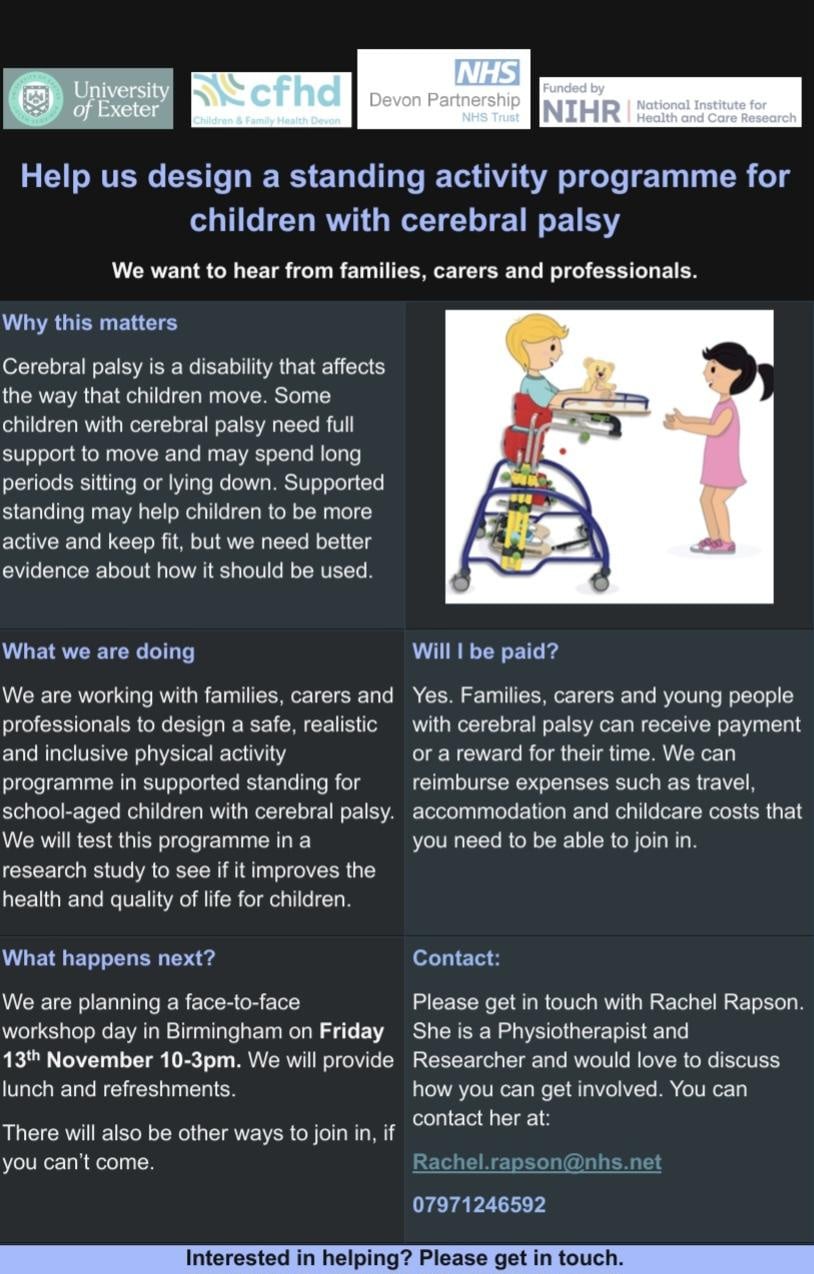
Help us design a standing activity programme for children with cerebral palsy
We want to hear from families, carers and professionals.
Why this matters
Cerebral palsy is a disability that affects the way that children move. Some children with cerebral palsy need full support to move and may spend long periods sitting or lying down.
Supported standing may help children to be more active and keep fit, but we need better evidence about how it should be used.
What we are doing
We are working with families, carers and professionals to design a safe, realistic and inclusive physical activity programme in supported standing for school-aged children with cerebral palsy.
We will test this programme in a research study to see if it improves the health and quality of life for children.
Will I be paid?
Yes. Families, carers and young people with cerebral palsy can receive payment or a reward for their time.
We can reimburse expenses such as travel, accommodation and childcare costs that you need to be able to join in.
What happens next?
We are planning a face-to-face workshop day in Birmingham on Friday 13th November, 10am–3pm.
We will provide lunch and refreshments.
There will also be other ways to join in if you can’t come.
Contact
Please get in touch with Rachel Rapson.
She is a Physiotherapist and Researcher and would love to discuss how you can get involved.
Email: Rachel.rapson@nhs.net
Telephone: 07971 246592
Interested in helping? Please get in touch.
The project involves the University of Exeter, Children & Family Health Devon, Devon Partnership NHS Trust, and is funded by the National Institute for Health and Care Research (NIHR).
Comments
-
The above post has been moderated and checked by the Cerebral Palsy Network Team.
Our website contains links to third parties’ websites for your information only. We have no control over the content of those sites or resources, and we don’t endorse or accept liability for the content of them.
Read the full Terms and Conditions and our Community House Rules.
0 -
Using AI…took 10 seconds !
A standing activity programme for children with cerebral palsy needs to be structured, safe, and evidence‑informed, combining supported standing with purposeful play, balance work, and functional skill practice. Below is a complete programme you can use or adapt, grounded in current clinical recommendations and research.
Core Takeaway
A strong standing programme for children with CP includes 30–60 minutes of supported standing daily, broken into meaningful activities that build bone density, hip development, balance, core strength, and functional mobility.
🧠 Why Standing Matters
Standing delivers measurable physiological and developmental benefits:
- Bone density & hip development — weight‑bearing reduces osteoporosis and hip displacement risk.
- Circulation, digestion, breathing — upright posture improves cardiovascular and respiratory function.
- Spasticity reduction — extension‑based weight‑bearing can temporarily reduce flexor tone.
- Social engagement — standing at peer height improves interaction and participation.
📅 Daily Standing Activity Programme (Structured Plan)
1. Warm‑up (5 minutes)
- Gentle trunk stretches — seated or supported.
- Weight‑shifting in sitting — prepares core muscles.
- Evidence shows sitting balance work improves trunk control and posture.
2. Supported Standing Block (30–60 minutes total)
Most guidelines recommend 30–60 minutes daily for children who cannot stand independently.
Use whichever stander is appropriate (prone, supine, upright, or mobile).
A. Static Standing (10–15 minutes)
- Maintain upright posture in the stander.
- Encourage visual scanning, reaching, or simple play at eye level.
- Helps bone density and hip development.
B. Dynamic Standing Activities (10–15 minutes)
- Reaching games — reach for toys placed left/right/up/down.
- Weight‑shifting in standing — gentle lateral shifts.
- Ball play — rolling or tapping a ball on a tray.
- These activities improve balance, coordination, and core strength.
C. Functional Standing Skills (10–15 minutes)
- Sit‑to‑stand practice**** (if appropriate) — repeated transitions build gross motor function.
- Supported stepping — in a mobile stander or gait trainer.
- Toy‑based tasks — stacking blocks, pressing buttons.
🎮 Activity Ideas by Ability Level
For children with limited trunk/head control
- Use supine stander or high‑support frame.
- Activities:
- Switch‑activated toys
- Visual tracking games
- Music‑based engagement
For children with moderate trunk control
- Use prone or upright stander.
- Activities:
- Forward reaching
- Side‑to‑side weight shifts
- Ball tapping
For children with good trunk control
- Use upright or mobile stander.
- Activities:
- Standing balance games
- Obstacle navigation
- Functional tasks at a table
📈 Weekly Progression Plan
A structured progression helps build tolerance and skill.
Week
Goal
Activities
Week 1
20–30 min standing tolerance
Static standing + simple reaching
Week 2
30–45 min standing
Add dynamic weight‑shifting + ball play
Week 3
45–60 min standing
Introduce sit‑to‑stand, stepping, mobile stander
Week 4+
Maintain 60 min/day
Increase complexity of games and functional tasks
🛡 Safety & Monitoring
Parents/carers should watch for:
- unusual fatigue
- increased resistance/spasticity
- skin pressure areas
- pain or discomfort
If these occur, pause and consult the physiotherapist.
📌 Evidence‑Based Principles Behind This Programme
- Standing frames are one of the most evidence‑supported interventions in paediatric CP care.
- Balance and core exercises improve coordination, posture, and mobility.
- Home programmes with repeated practice significantly improve functional motor skills.
0

Categories
- All Categories
- 16.4K Start here and say hello!
- 7.8K Coffee lounge
- 123 Games den
- 1.8K People power
- 188 Announcements and information
- 25.9K Talk about life
- 6.2K Everyday life
- 444 Current affairs
- 2.6K Families and carers
- 889 Education and skills
- 2K Work
- 630 Money and bills
- 3.8K Housing and independent living
- 1.2K Transport and travel
- 674 Relationships
- 1.6K Mental health and wellbeing
- 2.6K Talk about your impairment
- 885 Rare, invisible, & undiagnosed conditions
- 949 Neurological impairments and pain
- 2.3K Cerebral Palsy Network
- 1.3K Autism and neurodiversity
- 41.8K Talk about your benefits
- 6.2K Employment & Support Allowance (ESA)
- 20.6K PIP, DLA, ADP & AA
- 9.5K Universal Credit (UC)
- 5.4K Benefits and income